LinkedIn Ads are often praised for their precision targeting.
They enable you to reach decision-makers by job title, company size, and industry. Something that no other platform does so beautifully.
But having a precise list won’t automatically fetch leads into your pipeline. Even if your targeting is spot-on, your LinkedIn ad might still fail to get clicks.
Many marketers assume the problem lies in audience quality or bidding strategy, but most of the time, it’s something simpler- your audience just doesn’t want to click.
In this article, we’ll break down why your LinkedIn ads aren’t getting clicks, which ones actually matter, how ad formats perform differently, and what you can do to improve CTR (Click-Through Rate) without wasting your budget.
Not All Clicks Are Created Equal
When you open your LinkedIn Ads dashboard and see “clicks,” it’s easy to assume all of them are valuable. But not every click drives business results.
There can be two kinds of clicks you are getting on your LinkedIn ads:
- Meaningful clicks: These are clicks that lead users to your landing page, open your lead form, or push them further down the funnel. These clicks have intent.
- Empty clicks: These are vanity actions. Swiping through a carousel, clicking your company logo, or watching a few seconds of video without any follow-up action.
Understanding this difference helps you focus on the metrics that actually matter to your campaign ROI. You don’t just want clicks, you want actions that drive the pipeline.
Know Which Clicks You’re Actually Targeting
Before you chase higher CTRs, get clear on what type of clicks you’re after.
In B2B LinkedIn advertising, three major click types define your results:
- Traffic clicks – These take people from your ad to your landing page or lead form. They indicate curiosity.
- Conversion clicks – These turn curiosity into commitment– filling out a form, downloading a guide, or booking a meeting.
- Engagement clicks – clicks on the ad itself (like clicking “See more,” visiting your company page, or liking/commenting).
If your campaign objective is “Website Visits” or “Conversions,” you only want those chargeable clicks- the ones that take users to your site.
But if your ad creative encourages engagement (like thought leadership), you might get a lot of engagement clicks, not landing page clicks
According to The B2B House, the global average CTR for LinkedIn Sponsored Content is around 0.44%–0.65%. Anything below that means something’s off in your offer, creative, CTA, or message alignment.
📖 Source: The B2B House – LinkedIn Ad Benchmarks
Example:
Let’s say you’re running a Lead Gen campaign, but your ad copy invites people to “Learn more about our mission.”
People may click “See more” to read, but not click the lead form button.
Result: engagement ↑, Conversion ↓- even though your ad looks active.
The Ad Formats That Drive the Most (and Least) Clicks
Choosing the right ad format can make or break your CTR. Here’s how LinkedIn ad types stack up on engagement:
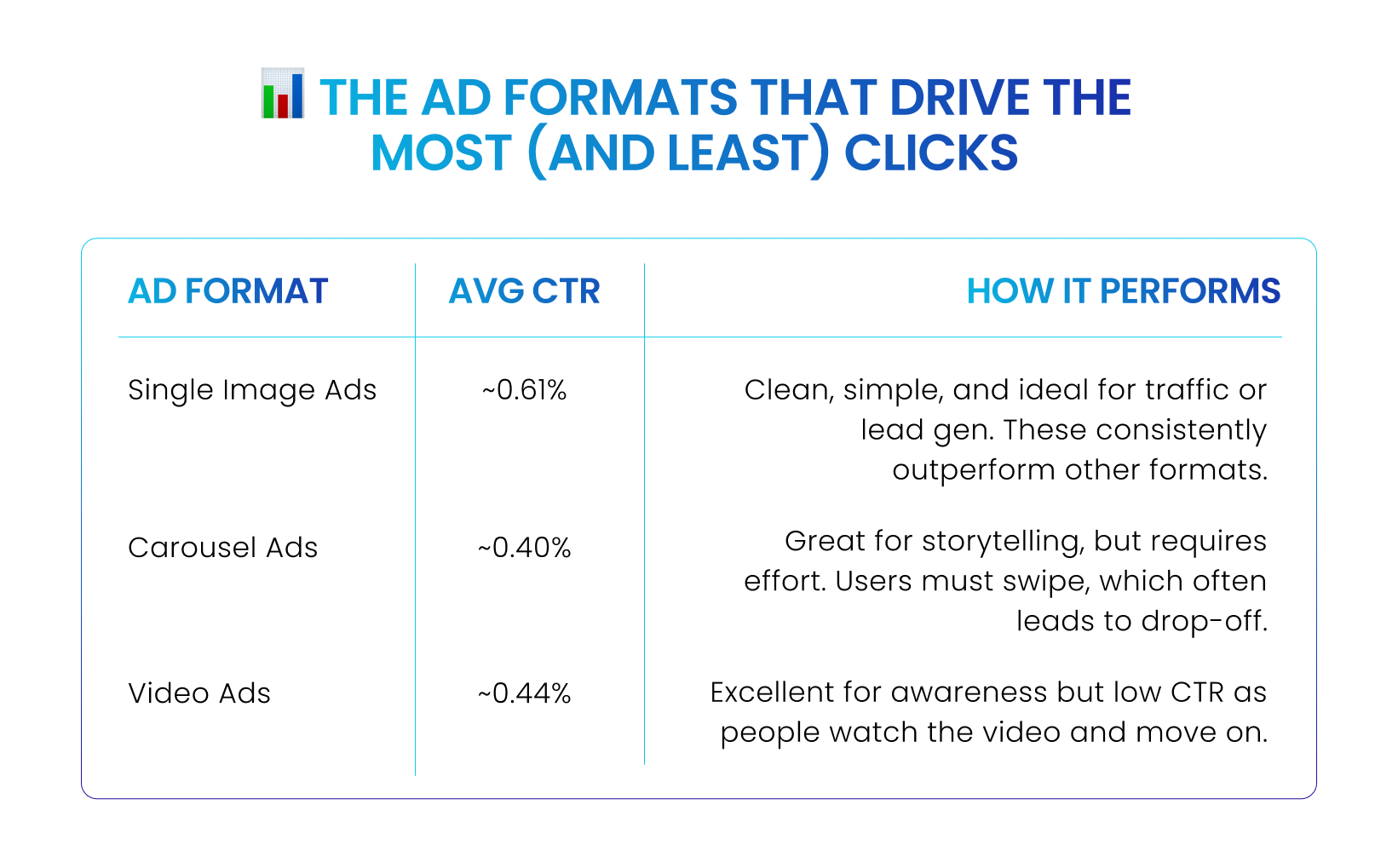
📖 Sources: ViewMetrics – LinkedIn Ad Benchmarks
If your goal is driving traffic or lead form fills, single-image ads often offer the best balance between engagement and cost.
How to Fix a Low CTR (Without Changing Your Targeting)
Once your audience setup is perfect, focus on the creative science behind the click.
Here’s how you can improve CTR meaningfully:
- Start with a pain-focused hook: Speak to your ICP’s biggest frustration, not your product feature.
Example: “Still managing B2B leads manually? You’re losing 20% of the potential pipeline.” - Match offer to funnel stage: Don’t show a “Book a demo” ad to a cold audience. Warm them up with content first. You can offer them a free lead magnet (also called a content offer) as a temporary fix to the problem they’re facing and that you can solve. Then cross-sell or upsell your original service or product- after your Ideal Customer Profile (ICP) already has a good impression of your brand.
- Pick the right format: If you’re optimizing for traffic or even the free content offer, avoid carousels and videos that add extra steps. Instead, use single-image ads (cheap and best) as its CTA appears right in front of your audience, and the hindrance between their curiosity and your lead-gen form/landing page is less. Hence, they tend to click more on single-image ads.
- A/B test your copy: Test tone, structure, and CTA verbs. Even subtle changes (like “Get the guide” vs. “Download now”) can swing CTRs by 0.2–0.3%.
- Design clickable visuals: Keep text minimal, contrast high, and CTA visible.
- Refresh creatives every 3–4 weeks: Ad fatigue kills CTR faster than you think. Keep changing the visuals and copy of your ad. (Check out this article on Creative Testing on LinkedIn Ads)
- Align landing pages: Don’t break the user’s expectation after the click. If your ad promises a report, don’t land them on a “Contact us” form. Brand reputation builds when you don’t trick your audience but actually provide value.
See, CTR is not magic; it’s alignment. You get more clicks when your offer and creative resonate with the stage your audience is in. And your ad copy and visuals are enticing enough for them to take a pause and interact.
When You’re Getting Clicks but No Meetings
Sometimes you do get clicks, but your calendar stays empty. That’s a different kind of problem.
Here’s what might be happening:
- Low-intent offer: Your ad is interesting, but not urgent enough to move people forward.
- Weak lead qualification: Too many unqualified clicks. Means your ad might be reaching people who just aren’t ready to buy.
- No nurture flow: You collect leads but never follow up with retargeting or email. It’s like inviting people over for dinner and then not showing up yourself. Buying from you is the last thing your LinkedIn ICP wants to do. It’s your job to persevere and woo them by following up diligently.
Clicks are a top-of-funnel metric. Meetings, demos, and deals are bottom-of-funnel outcomes. The goal isn’t just to drive clicks, but to make sure every click moves someone closer to a real conversation, closer to your brand.
The Bigger Picture: Don’t Worship CTR Alone
It’s tempting to treat CTR as the holy grail of campaign success but it’s just one part of the equation.
- A high CTR with no conversions or no growth from any angle- means you might be attracting the wrong clicks.
- A moderate CTR with high lead quality means your campaign is working exactly as it should- given your ad-objective was to generate leads.
The real magic happens when targeting, message, and offer all align to serve the same customer journey.
Because on LinkedIn, the goal isn’t the click- it’s the conversion behind it.
FAQs
- What’s a good CTR for LinkedIn ads?
According to Powered by Search, anything between 0.44% – 0.65% is average for Sponsored Content. Top campaigns often exceed 1%.
📖 Source: TheB2BHouse - Which ad format gets the best CTR?
Single-image ads generally outperform carousels and videos, offering a cleaner and faster click experience. - Why is my CTR high but conversions low?
You’re likely attracting curiosity clicks instead of intent clicks. Align your landing page and offer with your ad promise. - How often should I change my LinkedIn ad creatives?
Every 3-4 weeks or sooner if CTR drops below 0.4%. Fresh creatives re-engage your audience and help the algorithm re-learn. - Should I optimize for CTR or cost per lead?
CTR is an early indicator; CPL determines business impact. Optimize for both over time.