Your SaaS demo requests aren’t flatlining because your product is bad. But because your outreach strategy might still be operating on a 2022 playbook in a 2026 market.
If you have any experience with B2B cold emailing, you must have noticed that the inbox providers (Google, Microsoft, and Yahoo) have significantly tightened their filtering.
Simultaneously, AI-generated “noise” has reached a fever pitch, making prospects more cynical than ever.
If your cold email strategy hasn’t evolved, your messages are just being ignored by ESP (Email Service Provider) as well as your ICP (Ideal Customer Profile).
So, should you quit email marketing altogether? Absolutely not.
Emails are still the most popular marketing channel, especially in B2B.
Here is an audit of why your SaaS demo funnel might have stalled, along with the specific copy and CTA fixes required to revive it.
Mistake 1: The “I, We, Our” Trap (Copy Audit)
“But what’s in there for me?”
Write every cold email keeping this question in mind as if it’s coming from your prospect after reading every word on your email.
Nobody cares about how cool your SaaS features are. And if you take the email real estate to boast about your product instead of addressing the prospect’s pain, you have already lost their interest.
The most common mistake in SaaS outreach is making the email about the vendor instead of the prospect.
The Flaw: Starting an email with: “I’m the CEO of SaaS-Co, and we built a revolutionary platform that uses AI to optimize X, Y, and Z. Our customers love us because…”
By the time the prospect reaches the second sentence, they’ve already archived the email. Why? Because you haven’t given them a reason to care. In 2026, business leaders are dealing with “AI Fatigue” and “Budget Debt,” where every dollar spent on a new SaaS seat is a dollar taken from another priority.
The Fix: The “Prospect-First” Flip
Shift your opening line to a specific observation about their business. Yes, that means you have to customize each email, or at least the initial part.
For instance:
- Bad email hook: “I’d like to introduce you to our platform.”
- Good email hook: “I noticed [Target Company] recently expanded its sales team in EMEA, usually that makes [specific pain point] a nightmare to track.”
Mistake 2: The “Will You Marry Me?” CTA
Most SaaS companies treat the first cold email like a closing call. They ask for a 30-minute demo, a discovery call, or a “quick chat” in the very first touchpoint.
The Flaw: Ending an email to a stranger with: “Are you free for a 30-minute demo this Thursday at 2 PM?”
According to Instantly’s 2026 benchmarks, the average reply rate for B2B SaaS is just 3.43%. When you ask for 30 minutes of a stranger’s time, you are asking for a high-friction commitment. This leads to a “Micro-Decision” to delete the email simply to save time.
The Fix: Low-Friction, Interest-Based CTAs
Instead of a meeting, aim for a “reply.” Your goal for the first email is to get a “Yes” to a low-stakes question.
- Interest-Based: “Would you be opposed to seeing a 60-second video on how we solved [Pain Point] for [Competitor]?”
- The Permission Ask: “I put together a brief teardown of your current [Process]. Mind if I send the link over?”
- The “Soft” Question: “Is [Specific Goal] even on your radar for Q3?”
- Free lead-magnet: “I have created a [framework/tool/Excel template/calculator, etc] for your [specific problem]. Wanna have a look?”
Mistake 3: The “Wall of Text” (Formatting Audit)
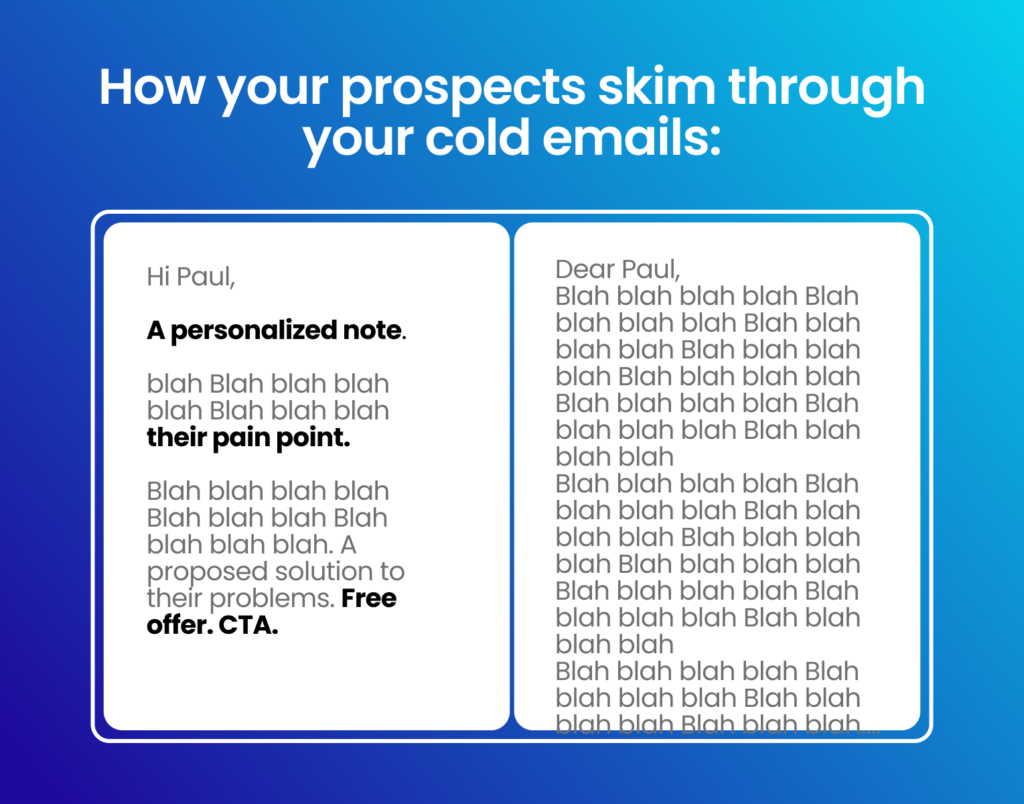
If your email requires the recipient to scroll on a mobile device, you’ve lost. Modern SaaS buyers scan emails in under 10 seconds.
The Flaw: Writing 200 words of “context” and “features” before reaching the value proposition.
The Fix: The 75-100 Word Rule
The sooner you wrap up your cold email, the more likely your prospect will respond. A few years ago, 125 words were considered an ideal length for a cold email. But lately, it has shrunk further to 75 words or even less.
But we know that sometimes, it might seem impossible to say everything important in under 75 words. So, we, at Shivyaanchi, take a middle path and keep the range as 75-100 words.
Here are a few important factors to help you write a supercharged cold email:
- The Hook (1 sentence): Why are you emailing them specifically? Or any other form of personalization.
You can also mention
- a small observation you found interesting about their business or
- any recent news about them or
- any interview or any podcast that they have recently featured on
- their recent LinkedIn post
- The Value (1-2 sentences): What specific ROI did you achieve for a similar company? (e.g., “We helped [Client] reduce churn by 14% in 90 days.”)
- The CTA (1 sentence): One clear, low-friction request.
Mistake 4: Technical Deliverability Debt
Sometimes, your copy is perfect, but your demo requests are flatlining because your emails are landing in the “Promotions” tab or Spam folder. Since early 2024, Google and Yahoo have enforced strict SPF, DKIM, and DMARC requirements.
The Flaw: Sending 500+ emails a day from your primary corporate domain (e.g., ceo@yourcompany.com).
If you get flagged as spam once, your entire company’s email deliverability, including your internal team communications, will tank.
The Fix: The Multi-Sender Strategy
To scale without risk in 2026, you must decouple your outreach from your main domain.
- Use Secondary Domains: For example, if your original site is abc.com, use abc.io or abc.co for outreach.
- Volume Limits: Keep individual accounts to under 30–50 sends per day to mimic human behavior.
- Warm-up Tools: Use automated warm-up services to maintain a high sender reputation by generating positive engagement signals (opens, replies, and “not spam” clicks).
Mistake 5: Lack of Multi-Channel Warm Up
Cold email does not exist in a vacuum. If a prospect receives an email from a name they recognize, the “Open Rate” skyrockets.
The Flaw: Sending a cold email to a prospect who has never seen your brand on LinkedIn or in their industry feeds.
The Fix: The “LinkedIn-Email” Sandwich
We recommend our clients run a sequence that warms the “digital air” before the email lands:
- Day 1: View the prospect’s LinkedIn profile (triggers a notification).
- Day 3: Follow them or interact with a recent post.
- Day 5: Send the first Personalized Cold Email.
- Day 7: Send a LinkedIn connection request referencing the email topic.
NOTE: You have to do the above-mentioned LinkedIn work manually, as LinkedIn has been cracking down on automation on its platform since last year.
Summary: The 2026 SaaS Outreach Checklist
To fix your flatlining demo requests, audit your current campaigns against this table:
| Element | Old Way (The “Flatline”) | New Way (The “Sniper”) |
| Opening | “I’m [Name] from [Company]…” | “I saw you recently [Trigger Event]…” |
| Length | 200+ words | <75 words |
| CTA | “Book a 30-min demo here: [Link]” | “Worth a 2-min look?” |
| Domain | Primary Company Domain | Dedicated Outreach Subdomains |
| Focus | Product Features | Prospect’s Business Outcomes |
Is your SaaS outreach sounding too much like a robot?
We help B2B firms bridge the gap between automation and authenticity. If your pipeline is dry, it’s time to stop “blasting” and start “conversing.”