Open your B2B outbound sequence analytics right now and look at your cold email response rates.
If you are tracking industry averages, you will likely find that your numbers have nose-dived.
According to the Instantly 2026 Benchmark Report, the average platform-wide cold email reply rates have plateaued at a bruising 3.43%.
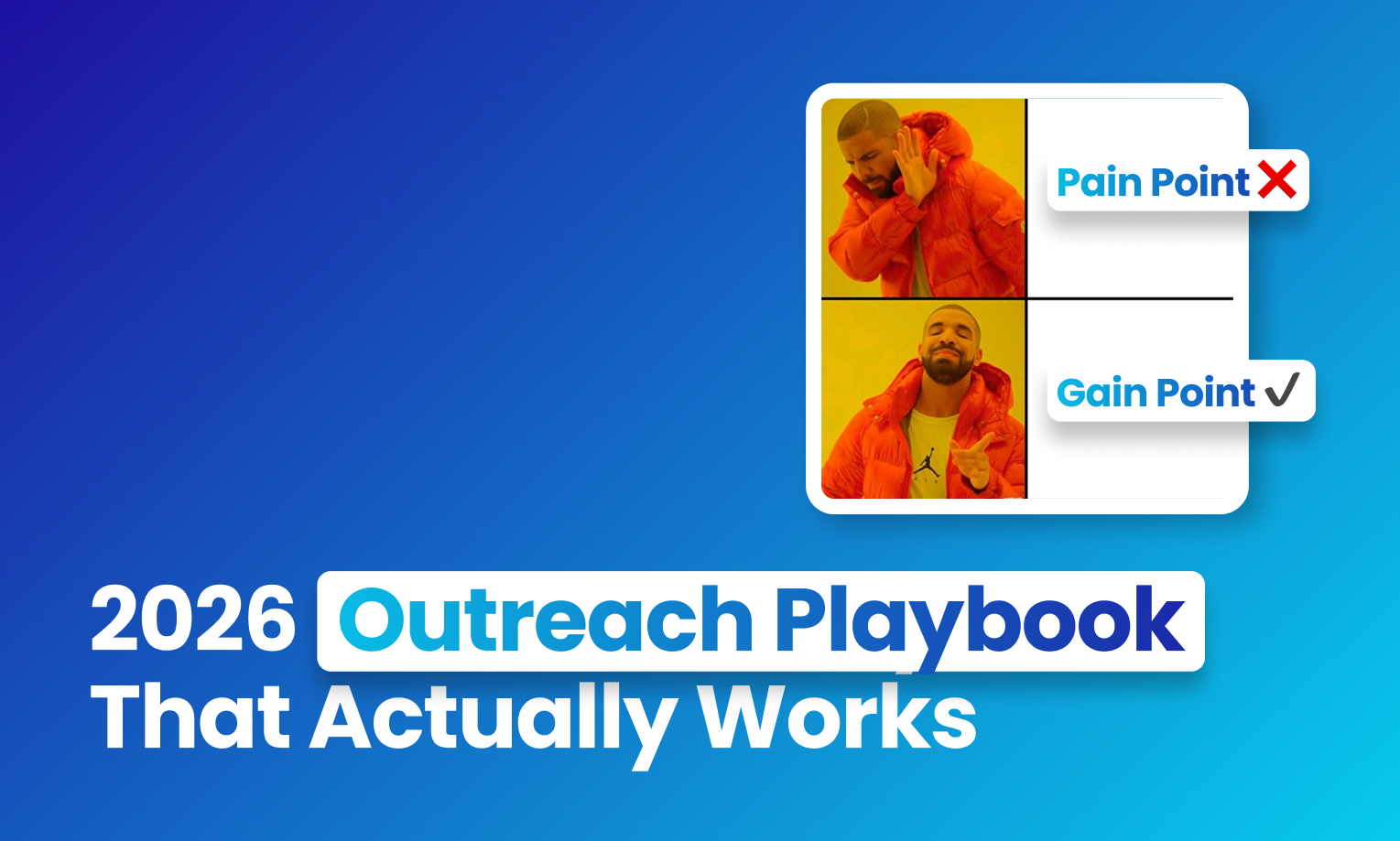
The reason for this drop-off isn’t just because inbox providers like Google and Microsoft have built tighter spam filters. It is because your prospects are suffering from chronic, acute “Pain Point Fatigue.”
For years, the gold standard of B2B copywriting was to poke the bruise. BDRs were trained to find a problem, amplify the misery, and pitch a cure.
But by 2026, AI-powered sales automation tools will have commoditized this approach. Every mid-market executive receives dozens of automated emails a week that start with the same pseudo-personalized formula: “I know you struggle with X…” or “Are you tired of losing hours to Y?”
When you tell a C-suite executive what they are struggling with, they are highly likely to think the message is robotic.
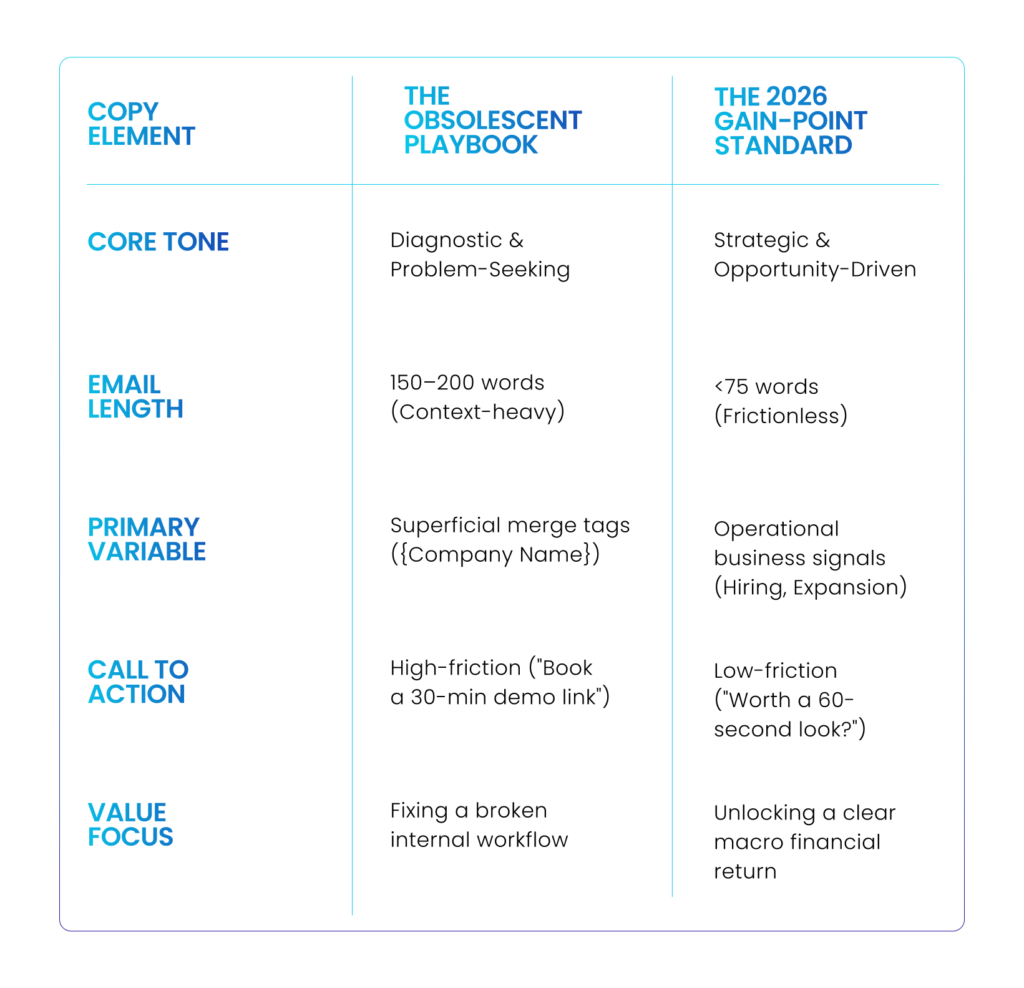
To break through the noise in 2026, you must abandon the obsolete playbook of fixing broken systems.
It is time to pivot to the “Gain Point” Framework– a psychological shift toward opportunity-focused, high-efficiency copy.
1. The Psychology of Enterprise Buyers in a Stabilizing Market
To write a copy that converts, you have to understand the economic environment your buyer is operating in.
Between 2023 and 2025, the B2B world was defined by defensive survival. Budgets were slashed, tech stacks were consolidated, and companies were desperate to cut immediate, bleeding pain points. Outbound emails that promised to “stop the bleeding” performed well because companies were in crisis mode.
But in 2026, the market has stabilized.
Enterprise organizations have already trimmed the fat, optimized their base operations, and cut underperforming software.
Today’s B2B buyer is no longer hiding in a defensive bunker; they are focused on market expansion, structural advantages, and long-term velocity.
When you send a cold email highlighting a basic operational “pain point,” the modern executive’s internal monologue is: “We’ve already optimized that. If it were a real issue, my director would have fixed it months ago.”
Enterprise buyers are desensitized to perceived problems.
They are, however, deeply competitive. Shifting your pitch from a pain point (solving a past negative) to a gain point (unlocking a future positive) alters the psychological power dynamic.
You stop positioning your SaaS or service as an administrative band-aid and start positioning it as a competitive lever.
2. Rewriting Hooks for Structural Advantages
Pain-point marketing focuses on an immediate malfunction. Gain-point marketing focuses on efficiency differentials and competitive leverage.
Instead of pointing out what a company is doing wrong, a gain-point hook observes what the company is doing right and shows them how to accelerate that momentum to scale even faster.
Consider how a standard B2B pitch translates when moving from the old framework to the new era:
Example A: Enterprise Telecom Outbound
- The Old Pain-Point Hook: “Are you dealing with dropped calls and network latency across your distributed branch offices?” (This assumes the buyer has a broken network, which insults their IT team’s capability.)
- The 2026 Gain-Point Hook: “I saw you added 14 logistics centers in the Midwest last quarter-usually, infrastructure expansion at that speed creates an opportunity to consolidate legacy data trunks into a single software-defined network, reducing cloud transport overhead by 18%.”
Example B: B2B Drone Inspection Solutions
- The Old Pain-Point Hook: “Manual infrastructure inspection is slow, dangerous, and causes compliance headaches for energy farms.” (This is generic information the prospect already knows.)
- The 2026 Gain-Point Hook: “We put together an operational model showing how regional wind assets can capture high-resolution thermal integrity data in 4 hours instead of 3 days, moving site data directly into asset management systems for immediate predictive scheduling.”
Notice the difference? The gain-point hook relies on signal-based triggers (such as job openings, regional expansions, or tech stack updates) to show the buyer an asymmetric advantage they haven’t yet capitalized on.
3. The C-Suite Formula: Writing Sub-75-Word Emails
If a C-level executive opens your email on a mobile device and sees a wall of text that requires scrolling, they will delete it immediately.
Data compiled across 53 million outbound messages in 2026 shows that emails containing between 50 and 75 words achieve reply rates that are roughly 50% higher than longer, explanation-heavy formats.
To hit this target length, you must strip away all fluff- including polite throat-clearing lines like “I hope this email finds you well” or long paragraphs detailing your company’s history. A pristine, sub-75-word gain-point email follows a precise, three-sentence structural arc:
The Cold Email Framework in Action:
![Sample of a B2B, high-reply rate cold email under 65 words for 2026 outreach Subject: Leverage point for [Prospect Company] infrastructure "Hi [First Name], I noticed your engineering team is scaling your autonomous fleet operations in Texas. > We recently helped a similar operation reduce data processing latency down to under 12 minutes, allowing their ground teams to act on telemetry reports almost instantly. Would you be open to a 60-second look at the architecture map we used?" See the example in the above picture? This entire message runs under 65 words. It respects the reader's time, relies on a real business signal, introduces a clear competitive gain, and ends with a soft, interest-based call to action rather than demanding a 30-minute calendar commitment.](https://shivyaanchi.com/wp-content/uploads/2026/06/Frame-27045-1024x773.png)
The Checklist: Auditing Your Copy for 2026
To ensure your outbound outreach campaigns don’t get trapped by pain-point fatigue, audit your active copy sequences against this diagnostic criteria:
Conclusion: Lead with the Horizon, Not the Hole
B2B decision-makers do not want to be reminded of their day-to-day operational headaches by a cold solicitor. They want to connect with partners who bring market intelligence, structural insights, and clear revenue or efficiency advantages directly to their inbox.
By killing off the generic pain point and leading with clear, concise gain-point opportunities, you instantly elevate your brand above the noise of automated blast campaigns.
Is your outbound outreach failing to generate positive replies?
At Shivyaanchi, we help enterprise B2B organizations, telecom providers, and cutting-edge tech firms design hyper-targeted, signal-based outbound engines that convert.
Let’s stop the spray-and-pray and start building your high-velocity pipeline today.