The executive coaching market is experiencing collective ad fatigue.
Try discovering the ads by executive coaches these days, and you will see a barrage of identical hooks targeting enterprise leaders:
“Ready to scale past the C-suite?” “Book a 15-minute strategy call to unlock your corporate purpose.”
“Feeling executive burnout? Click here to fix your career.”
If you are an executive coach running these types of campaigns, you have likely noticed a painful trend. Your cost-per-click is climbing, your intake application quality is dropping, and your ad budget seems to evaporate with very little pipeline or high-ticket revenue to show for it.
The problem isn’t your capability as a coach, nor is it the platform. The problem is a fundamental misunderstanding of market psychology. You are treating the enterprise leadership market like a fast-food drive-thru, assuming that every VP or C-suite executive who sees your name is hungry for a transformation right this second.
In reality, the B2B marketing world operates on a profound principle known as the 95:5 Rule, pioneered by the Ehrenberg-Bass Institute. When applied to executive coaching, it reveals a simple, liberating truth: at any given moment, up to 95% of your target market is not in a buying window. Only 5% are actively looking to hire an executive coach today.
If your entire marketing ecosystem is built around pitching that 5%, you are fighting a costly, exhausting war over a tiny slice of the pie while completely ignoring the 95% who will fund your business next quarter.
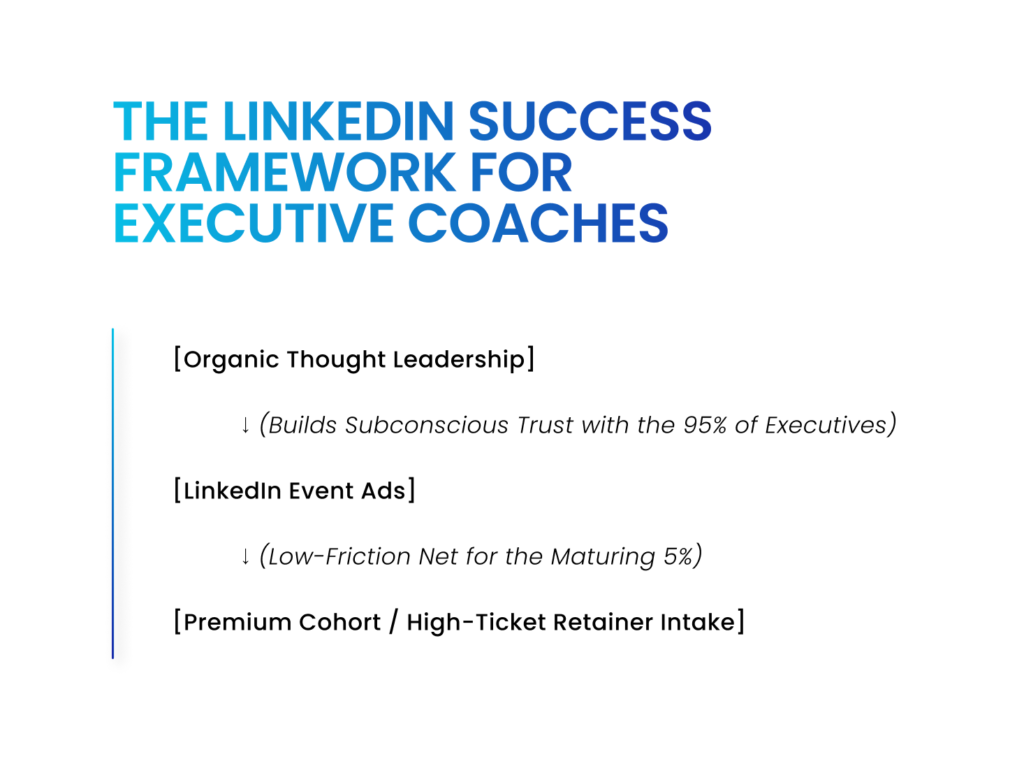
So, how do you capture your future corporate buyers as an executive coach? We recommend a mix of organic thought leadership and LinkedIn Event Ads that can help you build a predictable, high-revenue client acquisition engine.
Why “Book a Strategy Call” Ads Are Burning Your Budget
If you are a coach who’s designing your paid advertising campaigns with a direct-response mindset, and a direct call-to-action (CTA) like “Book a Discovery Session,” and targets mid-to-senior-level executives, know that this approach completely falls apart against the reality of the 95:5 Rule.
When a high-value prospect, say, a Vice President of Product at a tier-1 tech company, is cruising through their LinkedIn feed, their algorithmic and psychological defenses are on high alert.
If they are relatively satisfied with their division’s performance, mildly comfortable with their current roadmap, and not actively experiencing an identity crisis or boardroom battle, an ad shouting “Book a discovery call to transform your leadership style” feels incredibly high-friction. It demands their time, their vulnerability, and their calendar availability before they even know who you are.
By forcing a bottom-of-funnel conversion objective onto someone who is currently in that 95% “not buying” bucket, three negative things happen:
- Ad Fatigue and Muted Conversions: Your target audience sees your pitch over and over, recognizes it as a sales trap, and trains their brain to look past it.
- Wasted Capital: You pay premium LinkedIn ad dollars for clicks that immediately bounce because the mental leap from “scrolling my feed” to “pouring my heart out to a stranger on Zoom” is far too wide for an executive trying to manage their corporate reputation.
- Low-Intent Lead Volume: The few people who do click and book are often low-intent or low-income seekers looking for a quick, free advisory session rather than a premium, high-ticket retainer partnership.
To build a sustainable six-figure or seven-figure executive coaching practice, build a strategy that gently engages the 95% who are currently “comfortable but curious” so that you become their default, undeniable choice the exact day they step into a buying window.
How do you do that?
By Educating the 95%: The Power of Unpolished, Organic Thought Leadership
If you aren’t asking the 95% to buy from you today, what should you be doing with them? You should be educating them, challenging their perspective, and reducing their cognitive friction.
This is where organic thought leadership comes into play.
The human brain naturally craves pattern interrupts. In a feed crowded with corporate jargon and sterilized AI filler text, real authority is built when you share raw, unpolished, data-backed insights directly on the feed.
As an executive coach, your organic content should act as a mirror to your ideal client’s daily friction points. However, instead of pointing out simple malfunctions, you want to address macro-level shifts and deep corporate identity conflicts.
For example, instead of writing an organic post titled “3 Tips to Improve Your Executive Presence,” write a narrative breakdown exploring the psychological transition from execution to scale:
“The exact skill set that got you promoted to Director is the very thing holding you back from the VP level.
At the Director level, you are rewarded for being the ultimate problem solver.
At the VP level, you are evaluated entirely on your ability to build frameworks so that other people can solve problems.
If you are still stepping into the weeds every day, you aren’t being helpful- you are demonstrating that your organization cannot scale.”
Notice what this post does. It doesn’t ask for a sale.
It doesn’t gate a PDF behind a frustrating form. It simply hands the reader a paradigm-shifting insight for free.
The enterprise leader reading that post might be perfectly happy in their role today. Meaning they are firmly in the 95%. But you have just planted a flag in their subconscious. You have proven that you understand the nuanced, invisible ceiling they are bumping against. By consistently showing up with this level of intellectual depth, you are slowly earning their trust completely free of charge.
Deploying LinkedIn Event Ads For Executive Coaching
While organic thought leadership builds long-term equity with the 95%, you still need a mechanism to capture the 5% who mature into buyers every single month. You need a low-friction “digital front door” that bridges the gap between casual reading and commercial intent.
That net is the recurring, low-barrier monthly virtual event- supercharged by LinkedIn Event Ads.
Instead of asking an executive to leap from an organic post straight to a private strategy call, you invite them to an exclusive, high-value live masterclass or boardroom case study breakdown.
LinkedIn Event Ads are uniquely powerful because they utilize a native, one-click registration process.
- A prospect doesn’t have to leave the platform, wait for a slow external landing page to load, or even type in their work email and phone number.
- They click “Register,” and LinkedIn automatically completes the secure booking using their profile data.
To maximize the conversion rate of this funnel, you must pair the technical precision of Event Ads with elite, high-intent positioning.
If you are an executive coach targeting high-earning leaders, do not name your event “How to Pass Your Next Executive Interview.” That title attracts desperate, active job seekers who may be cost-sensitive.
Instead, position it around an elite narrative: “The Executive Pivot: The 3-Step Framework for Navigating 7-Figure Boardroom Offers Anonymously.”
By creating a highly specific, prestigious topic, you make it safe for currently employed, comfortable-but-curious leaders to register. They don’t feel like they are entering a high-pressure sales funnel; they feel like they are entering an exclusive masterclass of peers.
Also read: Why Nobody Is Clicking Your LinkedIn Ads
The True ROI of Event Funnels
Once the event registration is secured via your Event Ads, LinkedIn hands you an extraordinary asset: a clean, chronological list of every single attendee’s professional profile.
This attendee list completely transforms your sales cycle:
- The Warm Intake: You can review the profiles of everyone who registered, easily filtering for your ideal customer personas (ICPs) based on industry, seniority, or company size.
- The Post-Event Nurture: After delivering massive, ungated value during the live session, you don’t need to do an aggressive hard sell. You simply reach out to your highly qualified attendees with a friction-free message: “Thanks for joining the boardroom strategy session, [Name]. I noticed you had a great question about scaling frameworks. I’m putting together an exclusive advisory cohort of 8 corporate leaders next month to build these out personally. Would you be open to seeing if it matches your enterprise goals?”
Because they have spent an hour consuming your genuine expertise live, their defenses are completely down. The sales conversation becomes an extension of the value you already delivered.
Stop Building Half a Bridge
Paid ads buy you immediate attention, but organic authenticity buys you the actual conversion.
If you try to run paid ads without an organic trust layer, your client acquisition cost will break your business model. If you rely entirely on organic content without the distribution power of paid Event Ads, your growth will remain stagnant and unpredictable.
Hence, you should stop forcing your executive audience into immediate, high-pressure purchasing decisions before they are ready and embrace the 95:5 Rule instead.
Use your organic feed to continuously educate the future buyer, and deploy optimized LinkedIn Event Ads as the predictable monthly net that catches them the exact month they are ready to step up, scale their organization, and invest in your premium executive coaching.
Want to turn your leadership expertise into a frictionless revenue engine?
We have been working with coaches, helping them turn their LinkedIn profiles into lead goldmines on minimal budgets.
Let’s talk!