There’s nothing as frustrating as watching your high-performing LinkedIn ads suddenly lose their edge.
For weeks, your winning ad brought in a steady stream of qualified leads at a comfortable Cost Per Lead (CPL). Then, without warning, performance drifts. Click-through rates drop, costs creep up, and pipeline volume slows.
The knee-jerk reaction for many marketing teams is to declare that the creative is “fatigued” and replace everything. Other teams follow a rigid calendar rule: “It’s been 30 days, time to swap the creatives.”
Both approaches miss the mark.
Creative fatigue isn’t simply a matter of elapsed time, nor is it an excuse to scrap a winning campaign core. Refreshing your LinkedIn Ads too early kills winning campaigns prematurely, while waiting too long burns precious ad spend.
Here is how to read the true performance signals of LinkedIn ad fatigue, diagnose what is actually happening in your auction, and refresh your assets without destroying campaign momentum.
ALSO READ: What To Fix First In Your LinkedIn Ad? Ad Copy, Targeting, Or Landing Page?
What Creative Fatigue Actually Means (and What It Doesn’t)
Creative fatigue occurs when your target audience has been repeatedly exposed to the same ad creative or message to the point where they stop paying attention. The visual blindness sets in, responsiveness drops, and your auction efficiency degrades.
However, marketers frequently confuse a fatigued ad with a bad ad.
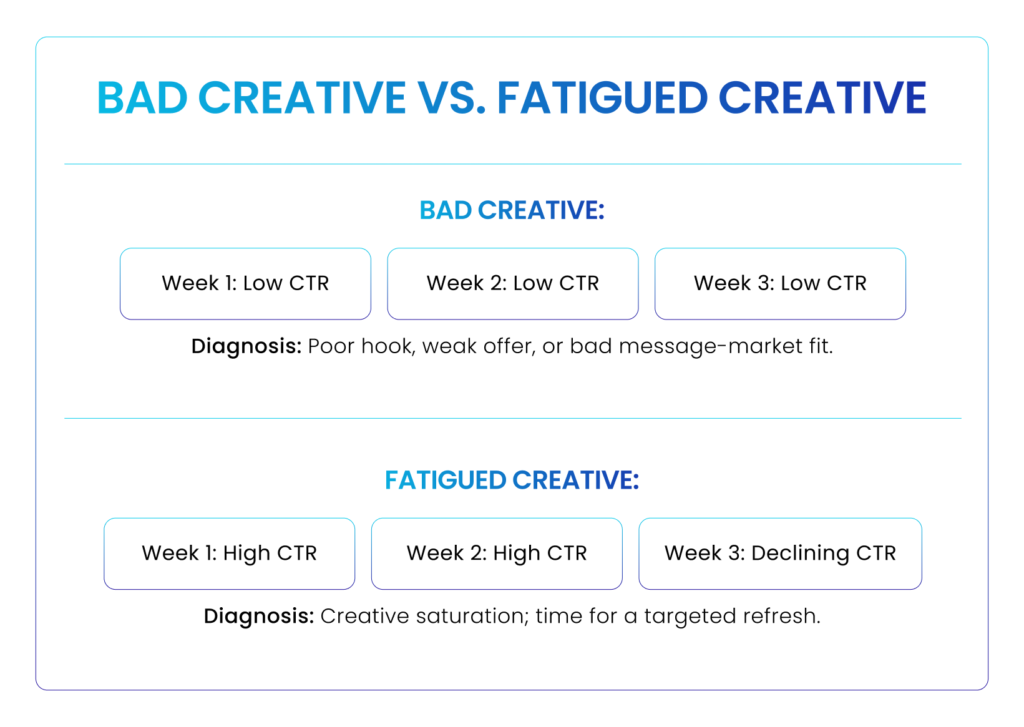
- A Bad Creative: An ad that generated low click-through rates and high CPLs right from launch. It never resonated with the target audience. It didn’t fatigue; it simply failed to connect.
- A Fatigued Creative: An ad that performed exceptionally well initially, delivering strong engagement, high CTRs, and efficient conversions, and then experienced a steady, measurable decline over successive weeks.
Don’t Refresh LinkedIn Ads Just Because the Calendar Says So
One of the most wasteful habits in B2B paid media is calendar-based creative swapping. Rotating ads every two to four weeks simply because “it’s time for a refresh” ignores auction mechanics.
If a LinkedIn ad continues to deliver qualified pipeline at an acceptable CPA, there is zero reason to retire it.
Some high-performing Thought Leader Ads or core value-proposition single images can run efficiently for months, especially in larger audiences where impression distribution happens slowly. Replacing an ad that is still converting efficiently resets the algorithm’s learning phase and risks replacing a proven winner with an unproven asset.
Let performance data dictate your refresh schedule, not the calendar.
The True Performance Signals of Creative Fatigue
Rather than relying on time frames, track your metrics week-over-week. Creative fatigue shows up across a cluster of interconnected signals rather than a single metric snapshot.
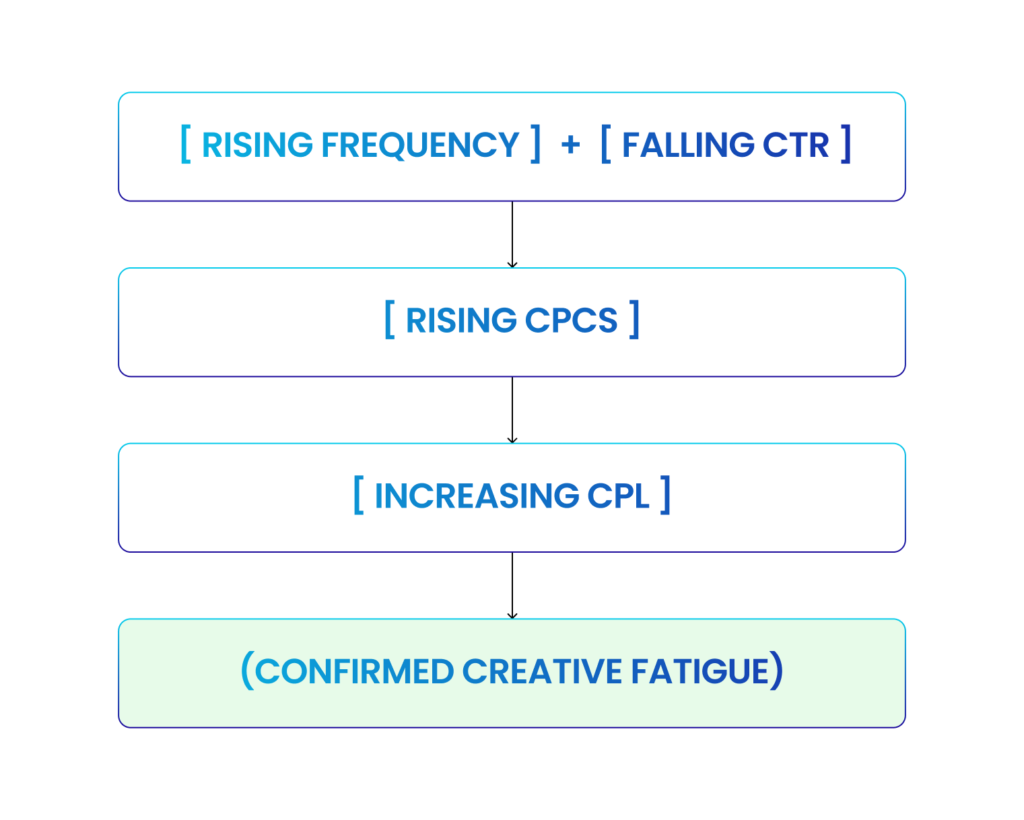
Look for these four core signals:
- Rising Frequency + Falling CTR: As the average frequency per user rises, your Click-Through Rate steadily declines. This is the clearest sign of visual burnout among your audience.
- Rising Cost-Per-Click (CPC): LinkedIn’s ad auction rewards ads with high relevance and engagement. When your CTR drops, LinkedIn views your ad as less relevant, forcing you to bid higher to win the same auction slot.
- Escalating CPL and CPA: As CPCs rise and engagement drops, your overall Cost Per Lead and Cost Per Acquisition climb week over week.
- Diminishing Multi-Week Trends: Never judge an ad on a single bad week. Holiday periods, seasonal shifts, or temporary auction spikes can cause single-week anomalies. Compare multi-week trends (e.g., Week 1-2 baseline vs. Week 5-6 current performance).
Why Frequency Alone Isn’t Enough
A common myth in LinkedIn advertising is that you must replace your ads as soon as campaign frequency reaches a specific number, such as 4 or 5
In reality, frequency context matters immensely:
- Remarketing & ABM Audiences: High frequency (6.0 to 10.0+) is often expected and beneficial when retargeting warm website visitors or a hyper-focused list of 50 enterprise accounts. In high-intent campaigns, repeated exposure builds trust and brand recall.
- Cold Prospecting Audiences: A rising frequency (e.g., 3.5+) paired with a steep drop in CTR usually signals that you have saturated the active, responsive subset of that cold audience.
Frequency is a context variable, not a decision trigger on its own. Always evaluate frequency alongside CTR and CPL.
Two Hidden Drivers of Accelerated Fatigue
If your ads seem to fatigue faster than expected, check these two structural campaign factors:
1. Audience Size Restrictions
Smaller audiences cycle through unique members significantly faster. If you are targeting a narrow niche of 5,000 decision-makers, a modest budget will hit high frequency within days, accelerating ad fatigue.
2. Budget Increases Without Audience Expansion
When you increase a campaign’s daily budget, LinkedIn doesn’t automatically reach a proportionally larger set of unique people. Instead, the algorithm often serves ads more frequently to the same highly responsive users first. Rapid budget scaling into a fixed audience size is one of the fastest ways to induce creative fatigue.
How Many Creatives Should You Run?
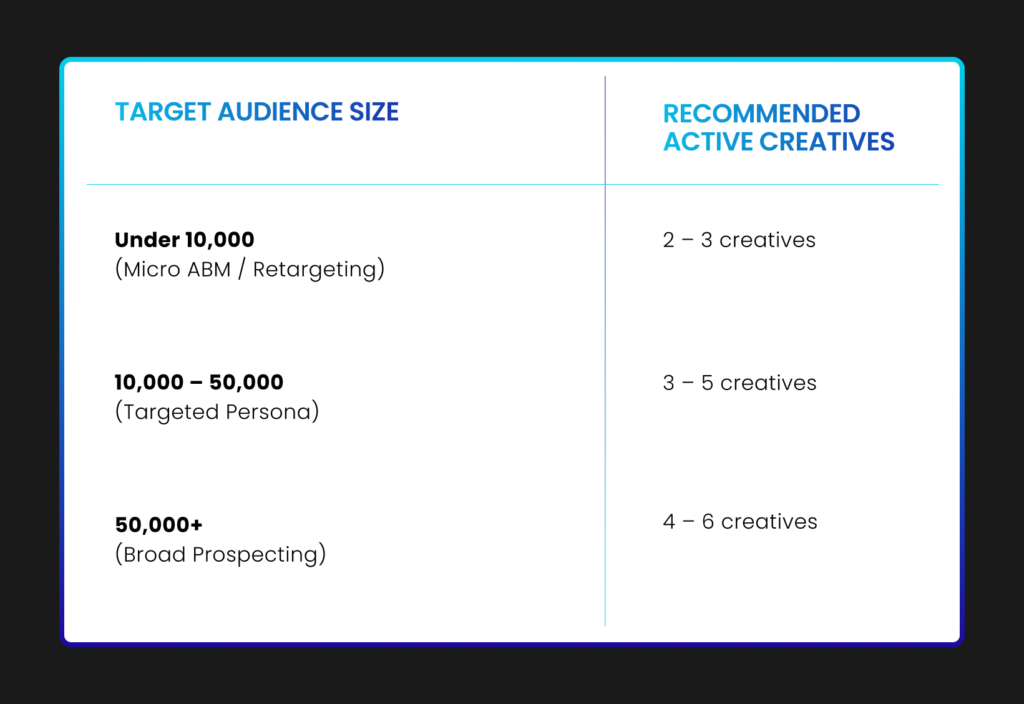
Running too few creatives leads to rapid fatigue. Whereas running too many dilutes your budget and prevents any single ad from gathering sufficient data to optimize.
As a general benchmark:
What a Creative Refresh Actually Means
Refreshing an ad does not mean launching an entirely new campaign, redesigning your brand identity, or throwing away your core value proposition. If your underlying offer works and the foundation is solid, the visual presentation or hook has gone stale.
A surgical creative refresh means tweaking specific levers one at a time:
- Format Switches: Convert a high-performing Single Image ad into a Document Ad (PDF carousel)
- Hook Testing: Keep the body copy and design intact, but change the first line of text or headline to address a different pain point.
- Visual Variations: Swap out static graphics for a product screen recording, an infographic, or a real human face.
- Proof Points & Angles: Shift the angle from a feature breakdown to a customer case study or a stats-backed industry benchmark.
Crucial Rule: Avoid changing everything simultaneously. If you change the audience targeting, landing page offer, body copy, and graphic design all at once, you won’t know which element improved or hurt performance.
Should You Pause the Old Winner?
When introducing fresh creative variations, do not automatically pause your historical winner.
Instead, introduce the new assets into the existing campaign as “challengers.” Allow LinkedIn’s auction algorithm to distribute impressions between the incumbent and the new variations.
If the original ad is genuinely fatigued, the algorithm will naturally shift budget allocation toward the newer, higher-engaging assets. If the original ad continues to capture impressions and convert at a lower CPL than the challengers, let it keep running.
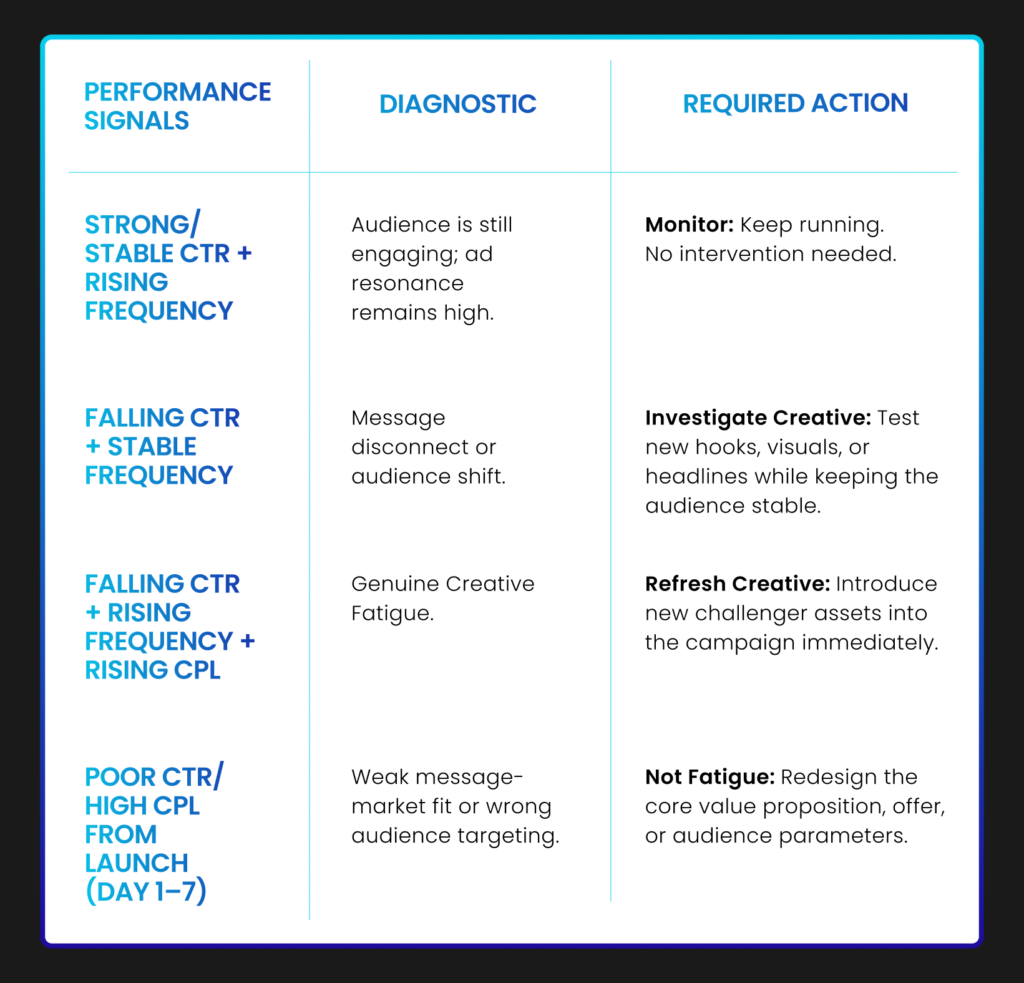
Practical Decision Framework For Reviewing Weekly LinkedIn Ads Performance
When reviewing your weekly LinkedIn ad performance, use this practical framework to determine your next move:
Basically, Don’t Let Creative Fatigue Ruin Your Lead Pipeline
Creative fatigue is an inevitable reality of B2B advertising on LinkedIn, but it doesn’t have to ruin your pipeline efficiency.
By tracking multi-week trends, ignoring arbitrary calendar swaps, and using surgical creative refreshes, you can maintain high relevance scores, keep acquisition costs predictable, and scale your campaigns without wasting budget.
Is creative fatigue or rising CPCs hurting your LinkedIn campaign performance? At Shivyaanchi, we design and manage high-performing B2B ad engines that combine continuous creative testing with deep pipeline tracking.
Let’s audit your LinkedIn ads and revive your pipeline.
Connect today