B2B Category Creation vs. Category Capture: Where Should Mid-Market Brands Spend Ad Dollars?
Every ambitious B2B founder dreams of becoming the “Gainsight of Customer Success” or the “HubSpot of Inbound Marketing.”
Category Creation is alluring because it means defining a new problem, naming a new solution space, and establishing your product as the undisputed category king.
However, for mid-market B2B brands operating with realistic, ROI-focused ad budgets, trying to educate an entire market on a problem they don’t know they have can quickly become a multi-million-dollar financial trap.
On the flip side, relying strictly on Category Capture, fighting over existing high-intent search traffic, can feel like bidding on hyper-inflated keywords in a red ocean.
So where should mid-market B2B companies allocate their paid growth dollars? The answer lies in a practical, data-backed evaluation of market maturity, buyer intent, and capital runway.
Defining the Dilemma: Creation vs. Capture
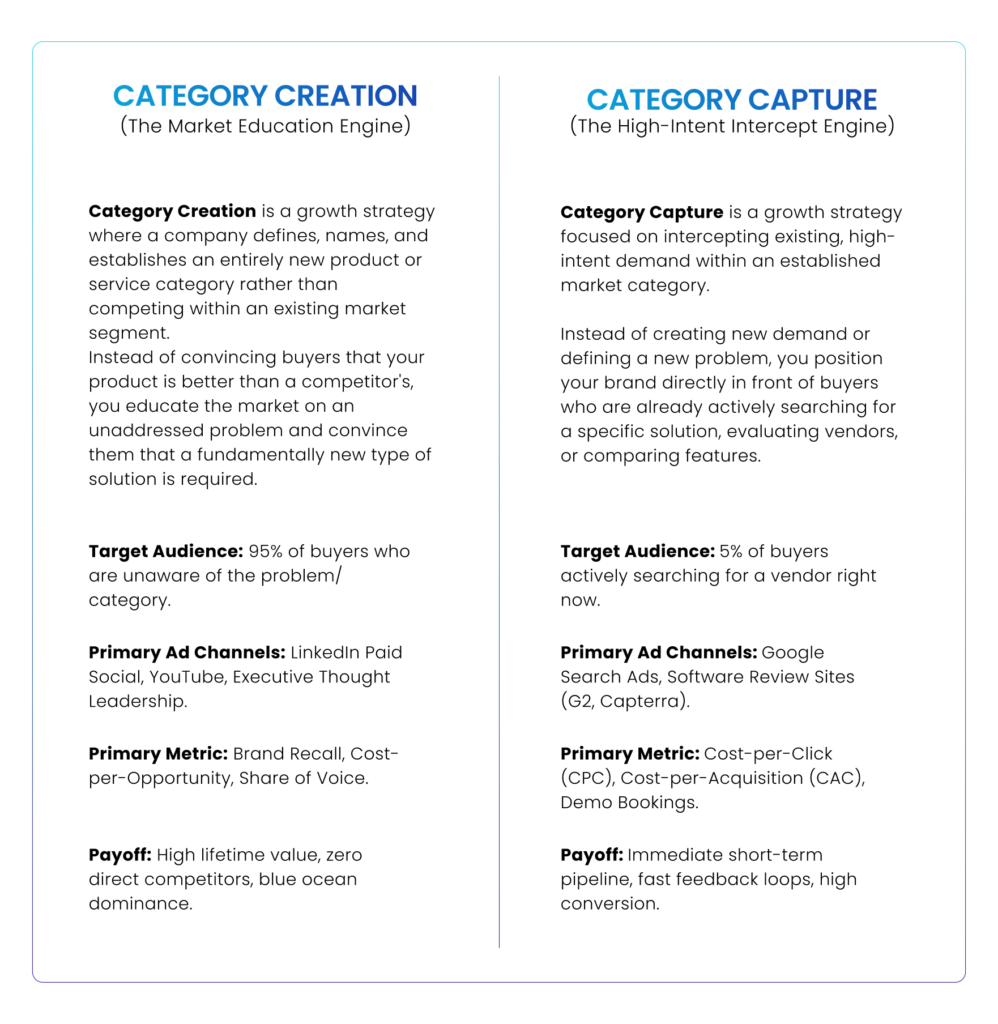
To allocate budget effectively, you must first separate the mechanics of these two paid growth engines:
The Hidden Cost of Category Creation for Mid-Market Brands
Category Creation is fundamentally an educational game, and market education is one of the most expensive undertakings in B2B marketing.
When you create a category, you aren’t just selling your product; you are forced to pay for two distinct marketing steps:
- Educate prospects that an unrecognized problem exists.
- Convince them that your newly named product category is the best way to solve it.
Enterprise market leaders (like Salesforce or Drift) can afford to sink millions into Category Creation because they possess massive venture backing or strong cash reserves to sustain long payback periods.
For a mid-market B2B brand generating $5M-$50M in ARR, spending 80% of your ad budget on Category Creation often yields high content engagement and great video views, but zero short-term pipeline. You end up educating the market, only for a well-funded incumbent to swoop in six months later, copy your messaging, and capture the category using their larger distribution engine.
The Trap of Solely Relying on Category Capture
If Category Creation is too expensive, why not put 100% of your paid budget into Category Capture?
While capturing high-intent search traffic via Google Search Ads or review sites like G2 is the fastest way to generate near-term demo bookings, it comes with severe limitations:
- Hyper-Inflation of CPCs: Keywords containing high commercial intent (e.g., “Best Enterprise CRM” or “Fleet Management Software”) regularly cost between $30 and $90+ per click.
- Volume Ceiling: Category Capture relies on existing search volume. Once you exhaust the 500 decision-makers searching for your software category each month, you cannot scale your spend without suffering diminishing returns.
- Commoditization: When you show up on a search results page alongside five direct competitors, you are forced to compete on features, pricing, and discounts rather than brand authority.
The 80/20 Capital Allocation Framework
For mid-market B2B companies looking to balance short-term pipeline demands with long-term brand equity, the solution is not choosing one over the other. The key is implementing a stage-gated budget split.
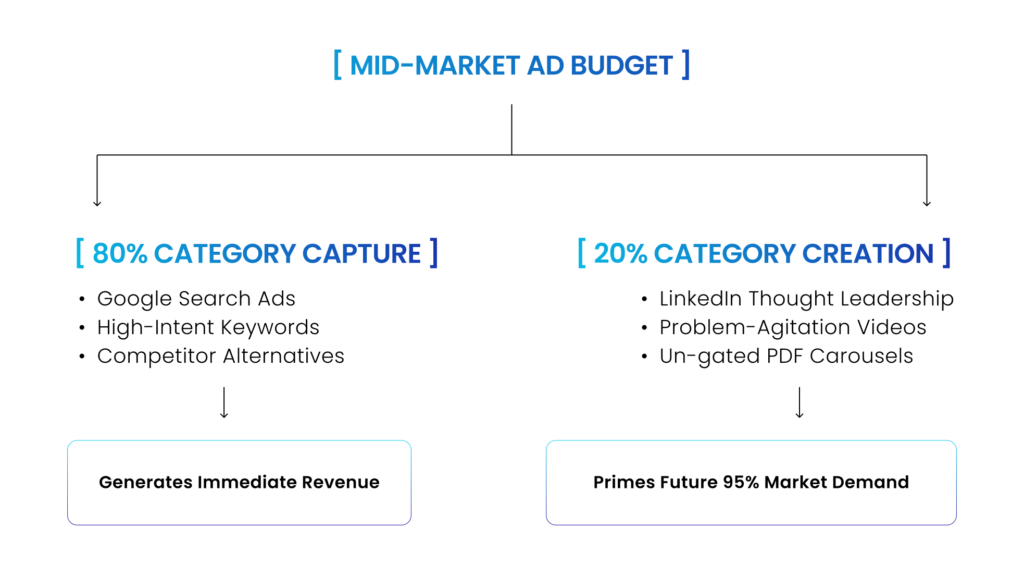
Phase 1: Maximize Category Capture First (The 80% Core)
Before spending a single dollar trying to create a new category, ensure you have completely captured the existing demand in your space.
- Action: Own high-intent Google Search terms, set up “Competitor Alternative” landing pages, and capture active buyers on review platforms.
- The Benchmark: If you have a budget left over after fully covering your high-intent search demand, only then should you shift capital toward demand generation and category creation.
Phase 2: Layer in “Category Frame” Ads (The 20% Growth Engine)
Instead of trying to invent a completely new, unrecognized category name (which confuses buyers), mid-market brands should focus on Category Reframing.
Category Reframing takes an existing category that buyers already budget for and repositions it around a specific, modern pain point:
- Example: Instead of telling buyers you invented “Autonomous Revenue Synergy Engines” (Category Creation), frame your product as “AI-Automated Outbound for B2B Agencies” (Category Reframing).
By anchoring your positioning to an existing line item in the CFO’s budget, you bypass the massive educational cost while still carving out a unique value proposition.
Evaluating Your Brand: Where Should You Spend Today?
To determine where your next $50,000 in ad spend should go, evaluate your current market positioning against these three criteria:
| If Your Brand Has… | Your Primary Ad Focus Should Be: |
|
(Focus strictly on search intent and bottom-of-funnel conversion) |
|
(Start building LinkedIn paid social demand generation) |
|
(Focus ads on the pain/problem, not the category name) |
Balance Pipeline Today with Positioning Tomorrow
Mid-market B2B brands cannot afford to burn capital on vanity category creation campaigns, nor can they scale sustainably by fighting over expensive, hyper-competitive search clicks forever.
By funding your immediate revenue needs through precise Category Capture, you generate the free cash flow required to systematically educate your market, reframe your category, and build lasting market dominance.
Is your B2B ad spend failing to generate a predictable pipeline?
At Shivyaanchi, we help mid-market SaaS and enterprise service firms design performance ad engines that capture existing demand while positioning your brand to win high-ticket buyers.
Let’s audit your ad channels today.
![[ UNGATED / LOW FRICTION ] ──► E-Book / Checklist ──► High Volume / Low CPL / Low Intent vs. [ HIGH FRICTION / HIGH INTENT ] ──► Demo / Discovery Call ──► Low Volume / High CPL / High Intent](https://shivyaanchi.com/wp-content/uploads/2026/10/Frame-27193-750x500.png)