When B2B performance marketers open LinkedIn Campaign Manager to build a new LinkedIn ads campaign, their first impulse is almost always the same: open the “Job Titles” field and start typing.
It makes intuitive sense. If you are selling enterprise legal software, you target “General Counsel” or “VP of Legal.” If you are selling a RevOps engine, you target “VP of Revenue Operations” or “Chief Commercial Officer.”
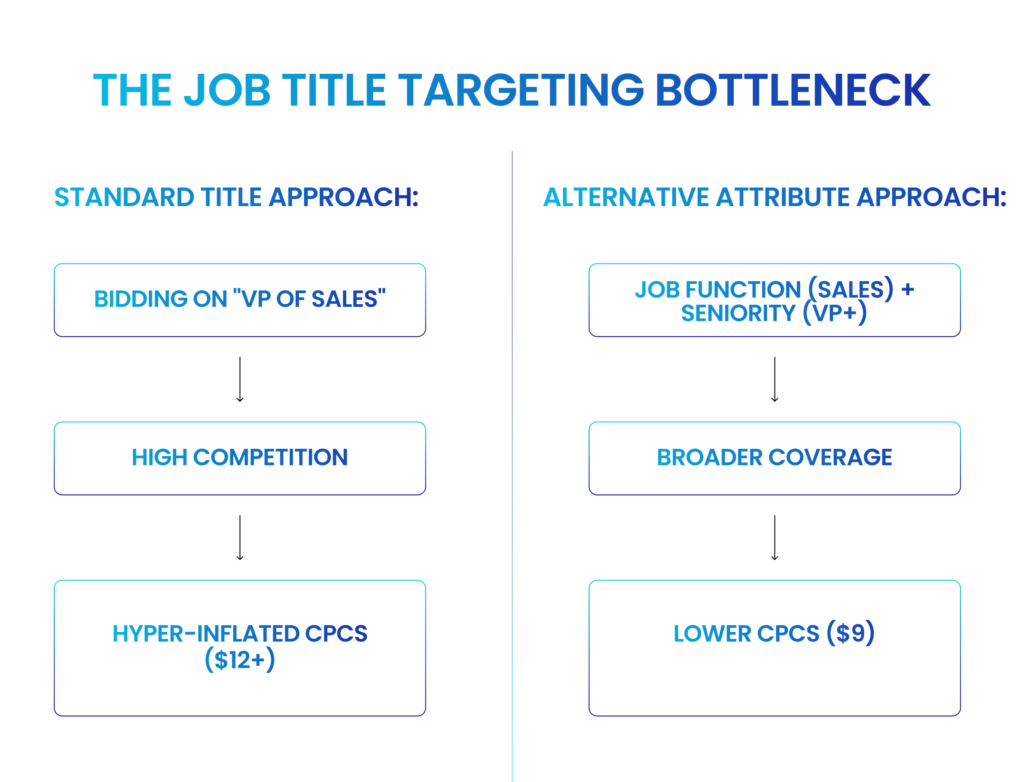
However, depending exclusively on exact job titles is one of the most common ways to artificially restrict your audience size, inflate your Cost Per Click (CPC), and miss crucial decision-makers on LinkedIn.
The best LinkedIn Ads audience isn’t necessarily the most narrowly defined audience. It’s the one that consistently reaches the right people and produces meaningful business outcomes.
Here is why relying solely on job titles limits your growth. And five alternative targeting strategies every B2B advertiser should test to unlock higher pipeline efficiency.
The Hidden Flaw of Job-Title Targeting
Job-title targeting seems precise on paper, but it overlooks how real-world B2B organizations operate. Relying exclusively on exact titles creates three distinct structural blind spots:
- Title Fragmentation Across Company Sizes: A “Head of Marketing” at a 30-person startup often holds the exact same purchasing authority as a “Senior Director of Growth” or “VP of Demand Generation” at a 500-person enterprise. If you only target “VP of Marketing,” you exclude dozens of equivalent decision-makers.
- Incomplete or Outdated Profiles: LinkedIn members do not always update their formal titles immediately upon promotion or job shifts. Furthermore, creative or non-standard titles (e.g., “Chief Revenue Catalyst” or “Growth Lead”) fall outside standard search queries.
- Hyper-Competitive Auction Pressure: Because every competitor in your niche is bidding on the exact same 15 obvious job titles, auction competition for those specific profile keywords skyrockets, driving up your impression costs (CPM) and click prices.
5 Alternative Targeting Strategies to Test
Rather than forcing LinkedIn’s algorithm to look for hyper-specific job titles, test these five alternative targeting combinations to capture the broader buying committee at lower acquisition costs.
1. Job Function + Seniority Level
Instead of listing dozens of explicit job titles, group your target audience by Job Function (e.g., Legal, Marketing, Operations, Information Technology) combined with Seniority (e.g., Director, VP, CXO, Owner).
- Why it works: This captures every senior decision-maker within a department, regardless of how quirky or specialized their exact job title is on their profile.
- Best for: Broad top-of-funnel prospecting where you need to reach departmental leaders across mid-market and enterprise organizations.
2. Member Skills + Seniority Level
LinkedIn allows you to target members based on the specific Skills listed on their profiles (e.g., Account-Based Marketing, Salesforce Administration, Commercial Litigation, SaaS Architecture).
- Why it works: Skills reflect what a professional actually does day-to-day rather than what their HR department decided to call their role. Pairing relevant skills with a Manager+ or Director+ seniority filter identifies experienced practitioner-executives.
- Best for: Technical B2B products, specialized RevOps infrastructure, or niche legal/compliance services.
3. LinkedIn Group Membership + Seniority Level
Professional LinkedIn Groups represent self-selected communities of interest. Targeting members of specific industry groups (e.g., “B2B SaaS Revenue Leaders” or “Corporate Counsel Network”) acts as a strong indicator of professional context.
- Why it works: Group members actively seek industry insights and peer discussions. When combined with seniority filters, group targeting isolates engaged professionals invested in solving specific business problems.
- Best for: High-ticket, specialized B2B offerings where topic interest is a stronger buying signal than a generic department title.
4. Company Lists + Professional Attributes (Account-Based Targeting)
If you operate an Account-Based Marketing (ABM) strategy, start with the company rather than the individual. Upload a matched list of target accounts (e.g., your ideal 500 target enterprise domains) and overlay broad departmental or seniority parameters.
![LinkedIn ads: Matched Account List (Top 500 ICP Companies) ]
│
▼ (Overlay Filter)
[ Job Function: Finance / Legal ] + [ Seniority: Director+ ]
│
▼ (Result)
100% Verified Decision-Makers at High-Intent Target Accounts](https://shivyaanchi.com/wp-content/uploads/2026/11/Frame-27239-1024x788.png)
- Why it works: You eliminate 100% of ad spend waste on unqualified companies. Within those pre-approved target accounts, you can afford to target a slightly broader set of titles to engage the entire 6-to-10-person buying committee.
- Best for: Enterprise sales teams targeting specific account tiers with high Average Contract Value (ACV).
5. Company Growth Rate / Industry + Job Function
LinkedIn provides company-level demographic filters, including Company Growth Rate, Company Size, and specific Industry Categories.
- Why it works: Targeting “Job Function: Sales” at “Companies experiencing 20%+ annual headcount growth” allows you to isolate scaling organizations experiencing severe growth friction- creating a timely hook for your solution.
- Best for: B2B agencies, software platforms, and RevOps consultants whose core value proposition addresses scaling pains.
How Different Targeting Approaches Impact Campaign Metrics
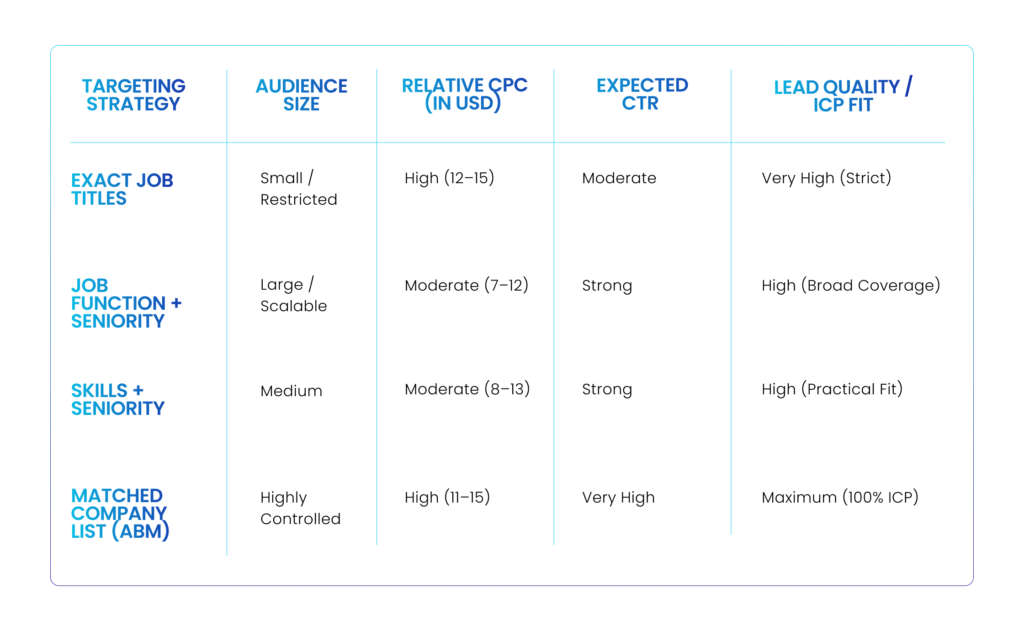
When shifting away from pure job-title targeting, expect your performance metrics to shift across the funnel:
Golden Rule: Avoid Over-Constraining Your Audiences
A frequent mistake when testing alternative targeting options is combining too many AND criteria in a single campaign.
For example, stacking Job Title AND Skill AND Group Membership AND Company Size AND Industry creates a hyper-restricted audience pool of 1,200 people.
When an audience is too small:
- Campaign delivery halts or under-paces.
- Frequency spikes rapidly, causing immediate creative fatigue.
- LinkedIn’s auction algorithm lacks sufficient delivery room to optimize impressions efficiently.
Targeting Benchmark: Aim for a cold prospecting audience size of 30K to 80K members for broad campaigns, and no smaller than 5,000 to 15,000 members for hyper-targeted ABM campaigns.
How to Structurally Test Alternative Targeting
To determine which targeting strategy delivers the best commercial outcomes, run a clean split test:
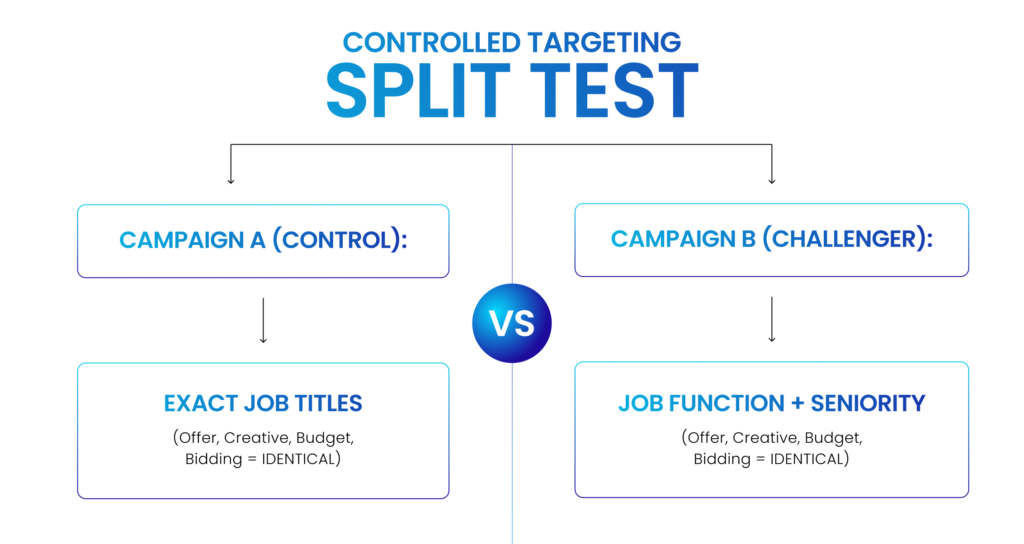
- Isolate the Targeting Variable: Keep the landing page offer, ad creatives, copy hooks, geographic settings, and bidding strategies 100% identical across both campaigns.
- Evaluate Downstream Quality, Not Just CPL: A lower Cost Per Lead (CPL) in Campaign B is meaningless if sales rejects those leads. Compare both campaigns on Cost Per Sales Qualified Opportunity (CPO) and Pipeline Value Created.
Look Beyond the Title Tag
Job titles provide a comfortable starting point, but they represent only a fraction of LinkedIn’s targeting capabilities.
By testing skills, job functions, group memberships, and account-based company filters, you expand your reach across the true B2B buying committee, lower your click costs, and build a more resilient acquisition engine.
Is your LinkedIn ad spend locked into expensive, hyper-competitive job titles?
We build and scale high-ticket B2B ad engines that combine advanced audience segmentation with deep pipeline tracking.
Audit your LinkedIn targeting strategy and discover your untapped pipeline.
Book a call today