When setting up a campaign in LinkedIn Campaign Manager, the platform makes its preferred choice unmistakably clear: Maximum Delivery (automated bidding) is set as the default option. LinkedIn promises that its machine learning algorithm will automatically set bids to maximize your results and spend your budget efficiently.
For B2B advertisers managing tight, highly controlled budgets, however, relying on automated bidding is often a fast track to inflated costs per click (CPC) and depleted ad spend.
While automated bidding algorithms sound efficient in theory, LinkedIn’s primary incentive under Maximum Delivery is to spend 100% of your allocated budget by buying impression volume, regardless of click efficiency.
For mid-market B2B brands running campaigns on monthly budgets of $3,000 to $10,000, Manual CPC bidding remains the most reliable strategy to maintain cost control, protect your acquisition economics, and make every ad dollar count.
Here is why Manual CPC is our preferred approach, how the mechanics of LinkedIn’s auction dictate click pricing, and when automated bidding might actually be worth testing.
Manual CPC vs. Maximum Delivery: The Mechanics
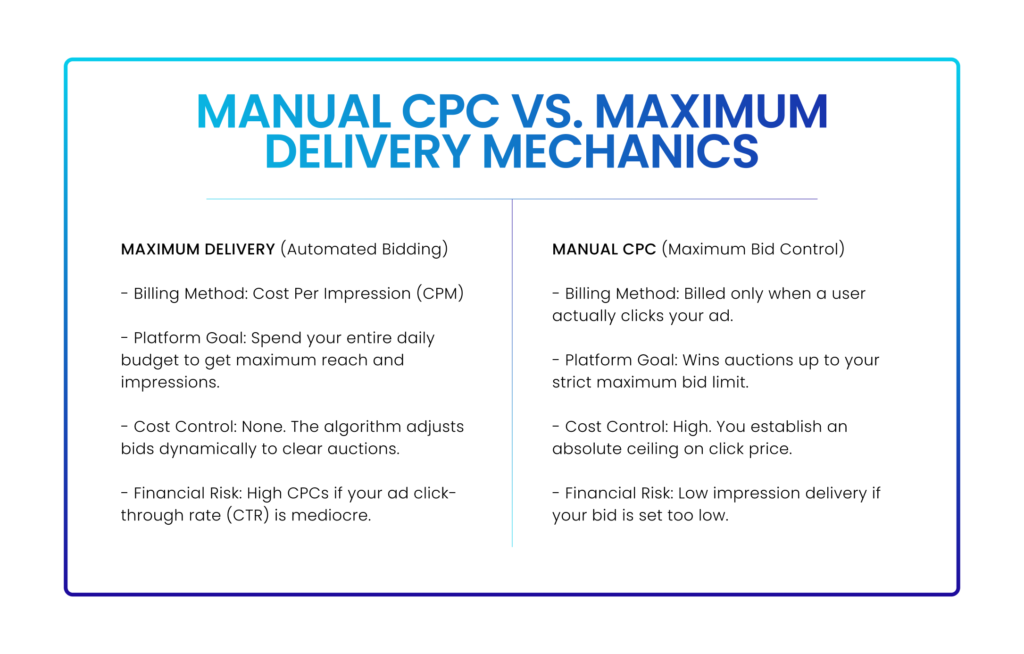
To understand why automated bidding often burns budget, you first have to look at how LinkedIn charges you under each bidding strategy:
The Hidden Penalty of Maximum Delivery
Under Maximum Delivery, LinkedIn buys impressions on your behalf. The platform calculates your Cost Per Click using a simple mathematical relationship:
CPC=CPM / (1,000 * CTR)
When you run Maximum Delivery, you pay for impressions (CPM) no matter what. If your creative generates an average or low Click-Through Rate (e.g., 0.35%), your effective CPC explodes because you are paying full price for impressions that fail to produce clicks.
Under Manual CPC, you flip this risk back onto the platform. You tell LinkedIn, “I am only willing to pay up to $9.00 per click.” If 1,000 people view your ad and nobody clicks, you pay $0.00. Manual CPC ties your advertising expense directly to user intent and engagement.
Why Manual CPC Makes Sense for Budget-Conscious B2B Brands
When working with modest monthly ad budgets ($3,000 to $5,000 per month), every click matters. Paying $18 per click under automated bidding means a $100/day budget yields just 5 clicks per day.
By taking manual control of your bids, you stretch your available capital significantly further:
1. You Leverage LinkedIn’s Second-Price Auction
LinkedIn operates on a second-price auction model. This means if you set a manual maximum bid of $10.00, but the next highest competitor bids $7.10, you only pay $7.11 to win the auction. Setting a strong manual bid acts as a safety ceiling, not an automatic charge.
2. Don’t Accept LinkedIn’s Suggested Bids at Face Value
When you select Manual CPC, Campaign Manager will suggest a bid range- for example, $11.50 to $16.00 per click.
Automated prompts urge you to bid within or above that range. However, you do not need to accept LinkedIn’s suggested bid.
Starting Strategy: Set your initial manual bid 25% to 30% below LinkedIn’s minimum suggested bid range.
Because LinkedIn’s auction considers ad relevance alongside bid price, high-quality ad creative paired with tight audience targeting often wins auctions at bids significantly lower than LinkedIn’s generic platform estimates.
![LinkedIn ads: Suggested Range: $12.00 – $16.00 ] │ ▼ (Discount by ~30%) [ Starting Manual Bid: $8.50 ] ──► Launch & Monitor Delivery │ ┌────────────┴────────────┐ ▼ ▼ (Spends Budget) (Underspends) Keep Bid Active Increase by 0.50-1.00](https://shivyaanchi.com/wp-content/uploads/2026/10/Frame-27231-1024x824.png)
What to Do When Manual Campaigns Underspend
Setting manual bids too low can cause a campaign to underspend or fail to deliver impressions. When a campaign delivers slowly, marketers often panic and switch back to Maximum Delivery.
Underspending is simply feedback from the auction. Before changing bidding strategies, diagnose the issue using a step-by-step approach:
- Verify Audience Size: If your targeting list is under 10,000 members, low impression volume is caused by audience constraints, not bid pricing.
- Increase Bids Incrementally: If delivery is sluggish, raise your manual bid by 10% to 15% every 48 to 72 hours until daily spend reaches your target pacing.
- Avoid Constant Daily Toggling: Making daily bid adjustments disrupts the campaign’s auction placement. Evaluate performance over 3 to 5-day windows rather than reacting to single-day fluctuations.
When Does Automated Bidding (Maximum Delivery) Actually Make Sense?
While Manual CPC is the optimal choice for 99% of B2B lead generation campaigns, Maximum Delivery has specific, valid use cases:
- Consistently High CTRs (>1.0%): If you have an exceptionally high-performing ad creative with a CTR well above industry averages (e.g., 1.2% or higher), switching to Maximum Delivery (or CPM bidding) can lower your effective CPC. When your CTR is high, buying impressions in bulk becomes cheaper than paying per click.
- Time-Sensitive Event Promotion: If you are running a campaign for a webinar or event happening in five days and need to burn through a fixed budget quickly to maximize reach, Maximum Delivery ensures rapid delivery.
- Uncapped Enterprise Budgets: Large enterprise brands prioritizing total Share of Voice and market reach over strict Cost Per Opportunity limits can use automated bidding to scale impression volume fast.
The Recommended B2B Bidding Workflow
To maintain control over acquisition efficiency while scaling delivery, follow this simple framework:
![LinkedIn ads RECOMMENDED BIDDING WORKFLOW 1. Launch Manual ] ──► Start with Manual CPC at 25-30% below the suggested bid. │ ▼ [ 2. Monitor Delivery ]──► If under-pacing, raise bids in 10-15% steps every 3 days. │ ▼ [ 3. Track CTR ] ──► If CTR > 1.0% consistently, test Maximum Delivery/CPM. │ ▼ [ 4. Protect ROI ] ──► If CTR drops or CPC spikes, return immediately to Manual CPC](https://shivyaanchi.com/wp-content/uploads/2026/10/Frame-27232-1024x928.png)
Retain Control Over Your Ad Capital
Automation tools built into ad platforms are designed to maximize platform revenue, not protect your campaign margins.
By using Manual CPC bidding, setting disciplined bid caps, and making incremental adjustments based on real delivery data, you protect your ad capital and build a performance marketing engine anchored in predictable ROI.
Is your LinkedIn ad spend failing to deliver predictable cost per opportunity?
We’ve been helping B2B companies see through the errors in their underlying LinkedIn ads. We have been designing and managing high-ticket B2B growth engines that optimize campaign architecture, audience targeting, and bidding logic for the past 12 years.
And we can help you take back control of your acquisition costs.
Let’s audit your LinkedIn ad account today!