Ask ten B2B marketers if they are running Account-Based Marketing (ABM) on LinkedIn, and eight will say yes. Ask them what that setup looks like, and most will describe the same workflow: export a CSV of 1,000 target accounts, upload it to LinkedIn Matched Audiences, layer on a broad job title filter, and serve the exact same brand awareness or demo ad used in their general prospecting campaigns.
That isn’t Account-Based Marketing but conventional lead generation with a company whitelist.
A company list tells LinkedIn where to show your ads. An ABM strategy determines who should see them, what they should see, and why.
True ABM on LinkedIn requires orchestrating multi-threaded engagement across specific buying committees, tailoring creative angles to distinct account segments, and aligning ad delivery directly with active sales outreach.
Here is how to move beyond basic company list uploads and build a genuine, pipeline-generating ABM engine on LinkedIn.
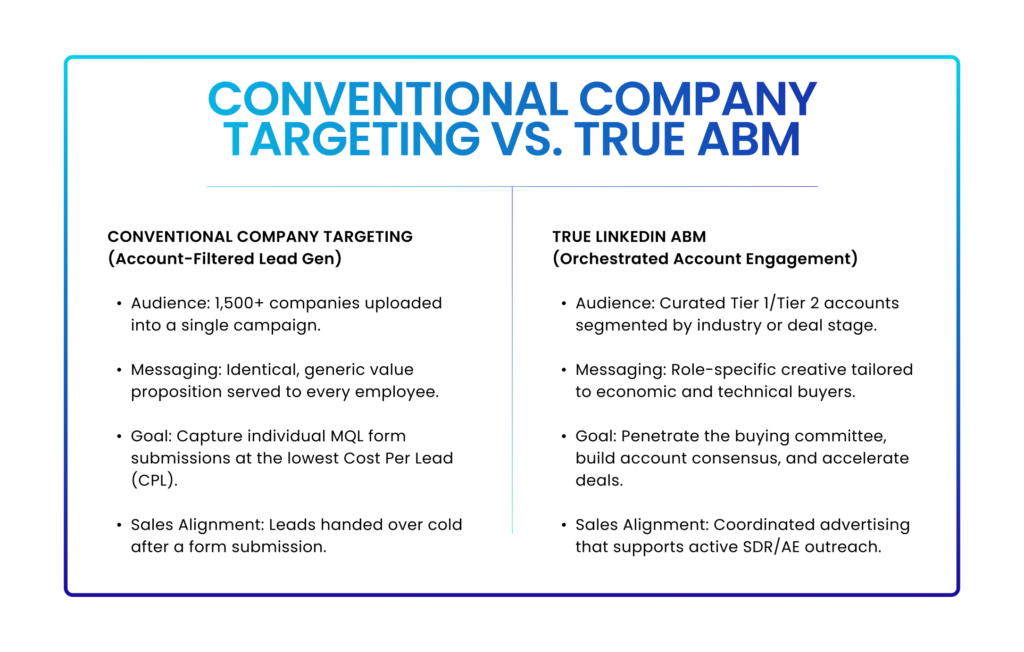
Conventional Targeting vs. True LinkedIn ABM
Understanding why simple list uploads fall short starts with separating standard demand capture from true account-based orchestration:
Why Uploading a Company List Isn’t Enough
When you upload a CSV of target companies without further architecture, three structural problems immediately undermine performance:
- You Reach the Wrong Roles Within the Right Companies: A Fortune 500 enterprise employs tens of thousands of people. If your persona filters are too loose, you waste budget serving ads to IT helpdesk technicians, junior coordinators, and HR associates who have zero influence over your deal.
- Generic Messaging Fails to Resonate: An enterprise Chief Financial Officer and a VP of Engineering care about completely different outcomes. Showing both of them the same generic product brochure ensures neither feels compelled to act.
- Single-Lead Obsession Misses Buying Committee Consensus: High-ticket B2B deals rarely close because one person downloaded a whitepaper. They close when 6 to 10 stakeholders inside an account recognize the problem and agree on your solution.
6 Steps To Build an Effective ABM Strategy Within Your LinkedIn Ads
1. Build and Tier the Right Account List
Effective ABM starts with ruthless account prioritization. Uploading 5,000 companies dilutes your budget so thinly that no single account receives enough impressions to build brand familiarity.
Instead, work with your sales leadership to tier your target list based on revenue potential, Ideal Customer Profile (ICP) fit, and historical win rates:
- Tier 1 (50–100 Strategic Accounts): Highest Average Contract Value (ACV), exact ICP match, active executive targets. These accounts justify dedicated budgets, hyper-relevant messaging, and coordinated AE outreach.
- Tier 2 (200–500 Mid-Market / Growth Accounts): Strong fit with moderate deal sizes. Group these accounts by vertical industry or shared business pain points to maintain efficiency at scale.
- Active Pipeline / Open Deals: Accounts currently sitting in SQL/ Opportunities in your CRM, requiring deal-acceleration air cover.
2. Reach the Entire Buying Committee
In enterprise B2B sales, winning a deal requires reaching distinct stakeholder personas simultaneously:
- The Economic Buyer (C-Suite, VP): Cares about ROI, payback period, risk reduction, and strategic competitive advantage.
- The Technical Evaluator (Directors, Architects, IT/Security): Cares about integration ease, compliance, data security, and implementation friction.
- The Day-to-Day Champion (Managers, Team Leads): Cares about workflow efficiency, ease of use, and solving daily operational headaches.
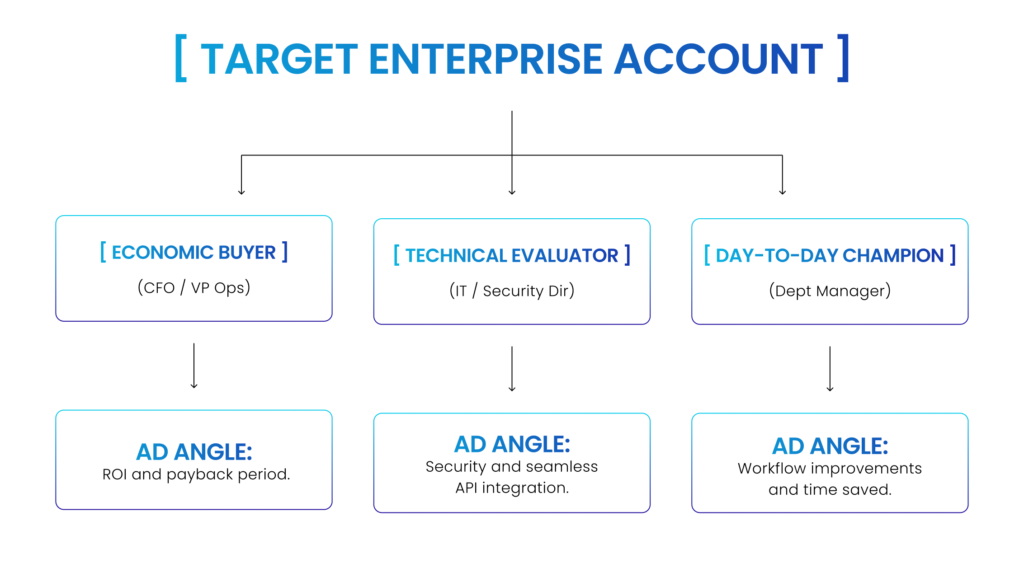 Rather than relying on one generic ad to convince everyone, run separate ad creatives. Or separate persona-specific ad sets, speaking directly to each stakeholder’s core priorities.
3. Personalize Ads Without Building 100 Campaigns
A common objection to ABM is operational complexity: “We can’t build 100 separate LinkedIn campaigns for 100 target accounts.”
You don’t have to. You can achieve high-impact personalization at scale by clustering accounts around shared attributes rather than individual company names:
- Vertical Industry Clusters: Group 150 healthcare SaaS accounts together and run ad copy calling out HIPAA compliance and healthcare sales cycles.
- Tech-Stack Clusters: Target accounts using Salesforce or HubSpot with creative highlighting native integration speed.
- Funnel-Stage Clusters: Sync CRM deal stages to LinkedIn Matched Audiences so accounts in active sales conversations automatically transition from awareness ads to customer case studies and ROI proof points.
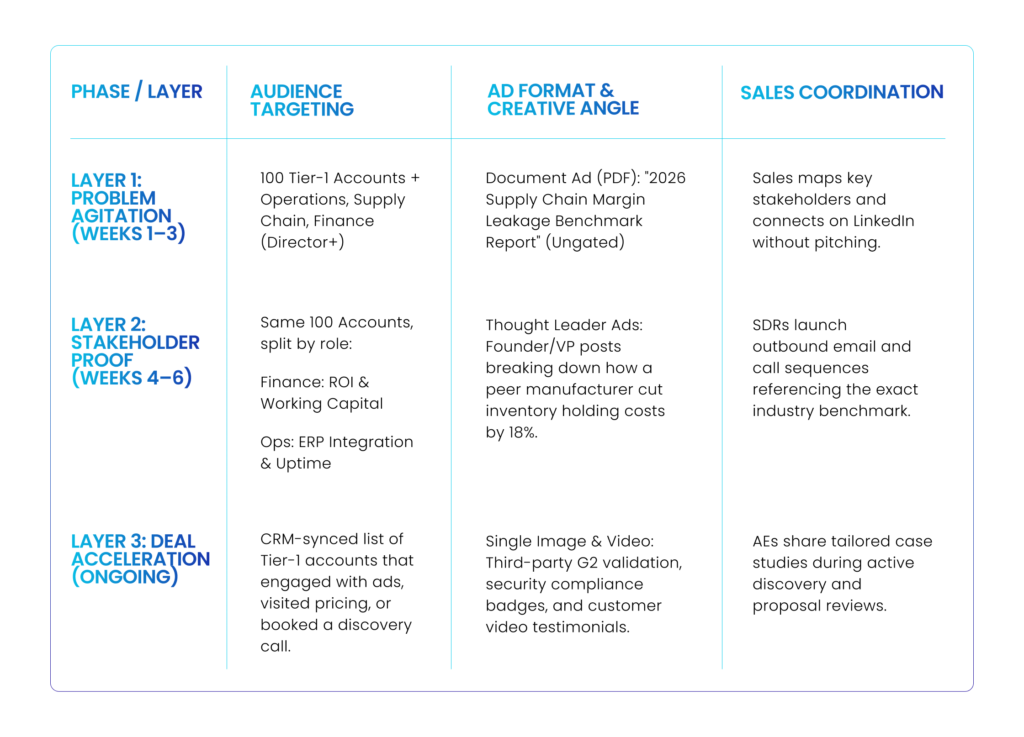
4. Practical Blueprint: An Enterprise SaaS ABM Rollout
Consider an enterprise industrial supply-chain SaaS company targeting 100 Tier-1 manufacturing accounts with an average deal size of $180,000:
5. Combine ABM with Intent & Retargeting Signals
Layering behavioral retargeting onto your static ABM list ensures you concentrate budget on accounts actively showing buying signals:
- Company Engagement Report Insights: Monitor LinkedIn’s native Company Engagement Report weekly. When an account jumps from “Low” to “High” engagement (multiple employees clicking, viewing videos, or visiting your company page), alert the assigned Account Executive immediately.
- High-Intent Website Retargeting: Combine your target account list with website retargeting rules so stakeholders who visit your pricing, security, or case study pages receive bottom-of-funnel conversion offers.
6. Measure ABM Performance Beyond CPL
If you judge an ABM campaign by Cost Per Lead (CPL), you will likely shut it down prematurely. ABM audiences are smaller, senior executives cost more to reach, and many enterprise buyers consume your ads without ever filling out a LinkedIn Lead Gen Form.
Evaluate LinkedIn ABM across account-level business metrics:
- Target Account Penetration: What percentage of your target account list received meaningful ad impressions (e.g., 5+ impressions per account) over the past 30 days?
- Account Engagement Rate: How many target accounts registered clicks, video completions, or company page visits?
- Outbound Reply & Meeting Lift: Do target accounts exposed to LinkedIn ABM ads show higher cold email reply rates and discovery call bookings than unexposed control accounts?
- Pipeline Influence & Win Rate: How much active sales pipeline is tied to engaged target accounts, and do those deals close faster?
4 Common LinkedIn ABM Mistakes to Avoid
- Uploading Oversized Lists: Putting 5,000+ accounts into one campaign spreads your daily budget so thin that individual accounts never reach sufficient impression frequency.
- Leaving Audience Expansion Enabled: LinkedIn’s Audience Expansion setting automatically serves ads outside your uploaded company list – defeating the entire purpose of ABM. Always turn it off.
- Judging Success by Form Fills Alone: Enterprise decision-makers rarely convert on cold lead forms. They research silently, discuss internally, and book meetings directly through your website or outbound rep.
- Running Marketing in a Silo: Running ABM ads without notifying your sales team wastes the warm brand awareness your ad dollars just created.
Orchestrate Consensus, Not Just Clicks
Uploading a company list to LinkedIn Campaign Manager is just data entry. Turning that list into predictable enterprise revenue requires strategic segmentation, role-specific storytelling, and tight sales-marketing alignment.
When you stop treating ABM as a lead-capture tactic and start using it to educate, surround, and build consensus across entire buying committees, LinkedIn becomes your highest-leverage enterprise growth channel.