![[ UNGATED / LOW FRICTION ] ──► E-Book / Checklist ──► High Volume / Low CPL / Low Intent vs. [ HIGH FRICTION / HIGH INTENT ] ──► Demo / Discovery Call ──► Low Volume / High CPL / High Intent](https://shivyaanchi.com/wp-content/uploads/2026/10/Frame-27193.png)
CPL in LinkedIn ads can be illusory- especially if you are new at it.
Ask any B2B marketing team which LinkedIn Ads campaign is performing best, and they will usually point directly to the one with the lowest Cost Per Lead (CPL).
It makes intuitive sense. CPL is immediate, easy to measure, and clean to report in a monthly executive deck. If Campaign A delivers leads at $35 and Campaign B delivers leads at $95, standard performance marketing logic dictates shifting budget straight into Campaign A.
In high-ticket B2B sales, however, optimizing for the cheapest CPL is one of the fastest ways to destroy ad ROI.
A $35 lead from a junior specialist with zero purchasing power or budget authority is expensive if it never generates pipeline. Conversely, a $95 lead from a VP or General Counsel at a pre-qualified enterprise account is exceptionally cheap if it converts into a $150,000 closed deal.
LinkedIn Campaign Manager tells you how cheaply you acquired a form fill. Your CRM tells you whether that lead was actually worth acquiring.
Here is why B2B advertisers must look beyond top-of-funnel CPL, how lower costs often mask poor lead quality, and how to align campaign optimization directly with pipeline and revenue.
The Illusion of the Low-CPL Campaign
To understand why low CPLs can be deceiving, consider how LinkedIn’s ad auction functions.
When you run campaigns on LinkedIn, bidding algorithms optimize for the path of least resistance to generate form fills within your targeting criteria. If your targeting includes a broad range of seniorities, the algorithm naturally serves ads to the most responsive, lowest-cost users, which almost always means junior professionals, students, or individual contributors who have time to scroll and click.
A Tale of Two Campaigns
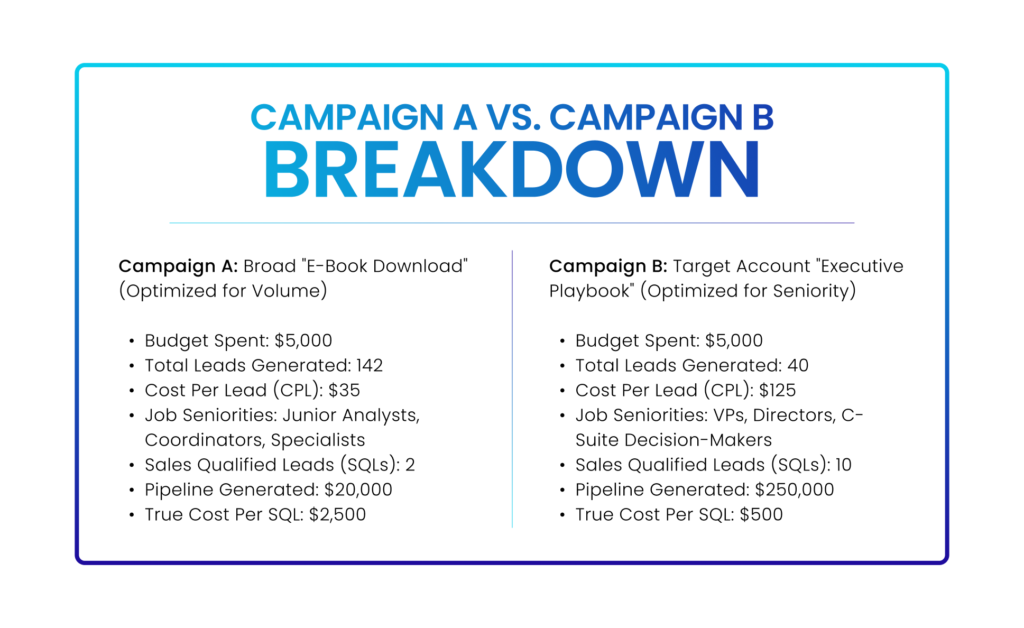
Consider two campaigns running simultaneously with identical $5,000 budgets:
If you evaluate these campaigns purely inside LinkedIn Campaign Manager, Campaign A looks like the clear winner with a $35 CPL compared to Campaign B’s $125 CPL.
However, when you look at downstream CRM data, Campaign B delivered 12.5x more pipeline at one-fifth the Cost Per SQL. Shift budget from B to A based on CPL alone, and you systematically starve your pipeline of genuine buying committee members.
3 Core Drivers That Inflate CPL (Without Decreasing Value)
When evaluating campaign economics, higher CPLs are often a natural byproduct of targeting higher-value audiences or asking for higher commitment.
1. Seniority Pricing Dynamics
C-Suite executives and VPs represent a limited, highly competitive audience on LinkedIn. Every enterprise advertiser is bidding to get in front of the exact same pool of decision-makers. Because supply is low and demand is high, acquiring a click or lead from a Chief Financial Officer inherently costs more than acquiring a click from a manager.
Paying a premium for high-seniority impressions is not inefficiency – it is the price of accessing buying power.
2. Offer Type and Conversion Friction
Different ad offers carry inherently different conversion economics:
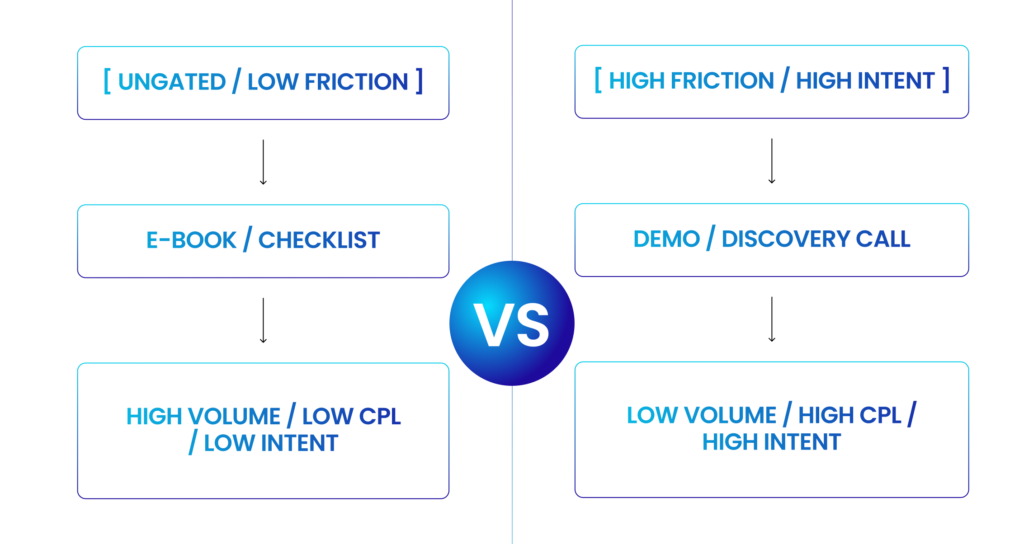
Comparing the CPL of a gated 3-page checklist against the CPL of a 1-on-1 strategy consultation is comparing apples to oranges. A $200 CPL for a high-intent demo request from a target account is frequently far more profitable than a $30 CPL for a passive whitepaper download.
3. Matched Audience vs. Broad Targeting
Running campaigns against a tight Account-Based Marketing (ABM) list of 300 target accounts will naturally yield higher CPCs and CPLs than running against a broad industry audience of 500,00 members. The ABM list has lower available inventory, but every single lead generated fits your Ideal Customer Profile (ICP).
What to Measure Alongside CPL
To prevent top-of-funnel metrics from distorting your marketing strategy, establish a multi-layered evaluation scorecard that combines ad platform signals with CRM intelligence:
![THE B2B OPTIMIZATION PROGRESSION
[ Top-of-Funnel ] CPL (Cost Per Lead)
│
▼
[ Quality Gate ] Job Title & Company ICP Match Rate
│
▼
[ Sales Gate ] MQL → SQL Conversion Rate
│
▼
[ Pipeline Gate ] Cost Per Opportunity Created
│
▼
[ Revenue Gate ] Closed-Won ARR & ROAS](https://shivyaanchi.com/wp-content/uploads/2026/10/Frame-27196-1-1024x928.png)
The 4 Crucial Quality Indicators:
- ICP Match Rate: What percentage of generated leads actually match your target company size, industry, and job function?
- MQL-to-SQL Velocity: How quickly do leads from a specific campaign pass sales qualification and accept an initial meeting?
- Pipeline Value Created: What is the total dollar value of active sales opportunities generated by the campaign?
- Cost Per Opportunity (CPO): Total ad spend divided by the number of validated sales opportunities created. CPO is a far more reliable indicator of ad efficiency than CPL.
How CRM Integration Transforms LinkedIn Ads Optimization
Optimizing LinkedIn Ads without a two-way CRM integration (such as HubSpot or Salesforce) is like driving with your eyes closed. You see where you spent money, but you have no idea where you made money.
By connecting your CRM data back to LinkedIn Campaign Manager, you can:
- Track Lead Quality by Ad Creative: Discover which specific ad messaging hooks or formats attract enterprise buyers versus job seekers.
- Feed Conversion Data Back to the Algorithm: Pass offline conversion events (such as “Stage 2 Opportunity Created”) back to LinkedIn to train the algorithm to optimize for high-value prospects rather than raw form fills.
- Audit Sales Feedback Loops: Prevent sales teams from dismissing lead channels by providing clear attribution proof from ad click to closed deal.
Efficiency Still Matters. Just Don’t View It in Isolation
Advocating against CPL-only optimization does not mean cost efficiency is irrelevant.
If two campaigns target the exact same senior decision-makers at the exact same target accounts with the exact same offer, then lower CPL is indeed the superior metric. Cost efficiency matters deeply but only after lead quality and audience alignment have been strictly verified.
Never allow a low CPL to hide a low-quality audience, and never kill a high-CPL campaign that is quietly funding your sales pipeline.
Optimize for Revenue, Not Metric Convenience
The goal of B2B performance advertising is not to collect the cheapest possible contact information. It is to generate a predictable, high-margin pipeline for your sales organization.
By looking past LinkedIn’s default surface metrics, integrating your CRM data, and judging campaigns on Cost Per Opportunity rather than Cost Per Lead, you ensure that every ad dollar spent builds real business value.