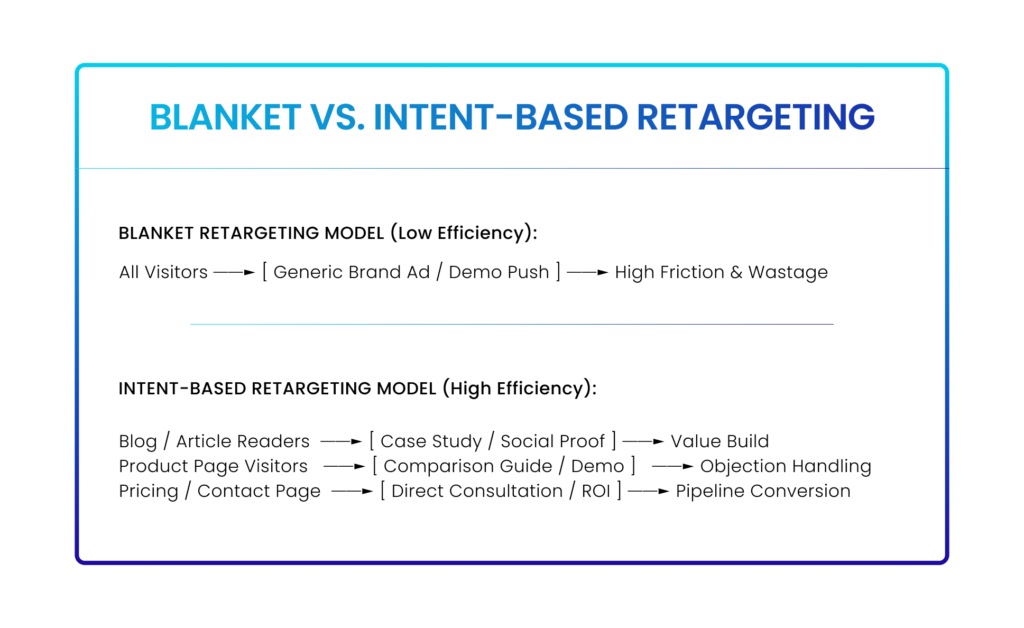
Setting up website retargeting on LinkedIn follows a predictable pattern: drop the LinkedIn Insight Tag on the site, create a blanket 90-day “All Website Visitors” audience, and serve them the same static brand image or generic promotional offer.
It feels efficient, but in practice, blanket retargeting treats every site visitor as if they have the same level of intent.
A prospect who stumbled onto a top-of-funnel blog post from an organic search query has a vastly different relationship with your brand than a decision-maker who spent four minutes on your pricing page or reviewed three customer case studies. Serving both of them the same “Book a Demo” ad is a classic message-market mismatch.
Retargeting should continue the conversation, not restart it.
Here is how to structure a high-converting LinkedIn Ads retargeting strategy based on user behavior, intent signals, and funnel progression, without falling into common delivery traps.
The Failure of Generic Retargeting
When you group all website traffic into a single retargeting bucket, you create two major performance bottlenecks:
- Irrelevant Messaging for Low-Intent Visitors: Pushing a direct sales demo or free trial to a casual blog reader who barely knows your company name causes immediate banner blindness and inflates your Cost Per Lead (CPL).
- Redundant Messaging for High-Intent Visitors: Showing generic “What We Do” brand awareness graphics to prospects who just visited your enterprise pricing page is a wasted opportunity to address specific objections, present proof points, or close the deal.
1. Segmenting Audiences by Intent Signals
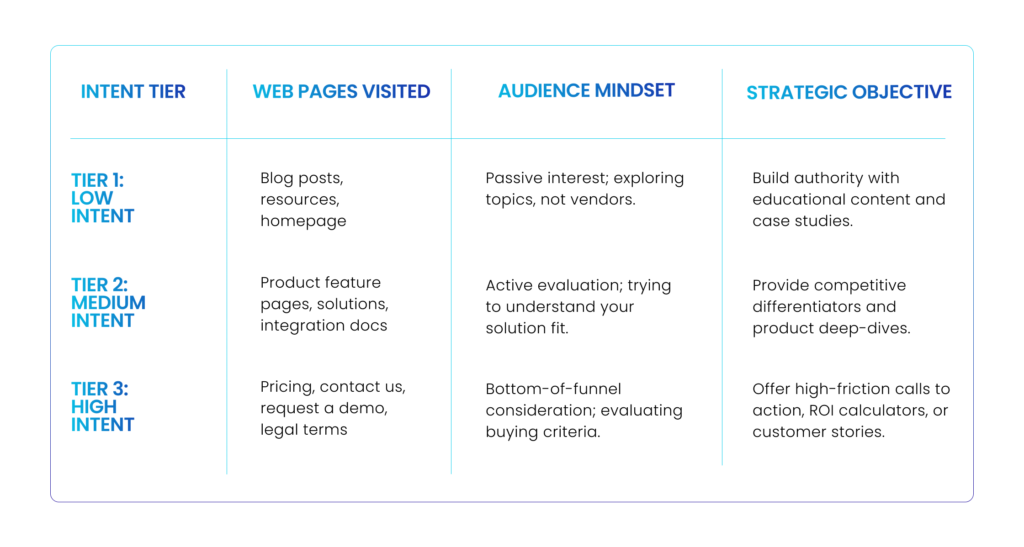
To build an effective retargeting architecture, group your site visitors into distinct intent tiers based on the URL structures they accessed:
2. Leveraging LinkedIn’s Native Engagement Retargeting
Website URL traffic is only one piece of the retargeting puzzle. Modern B2B buyers often interact heavily with your brand directly inside LinkedIn without ever clicking through to your site.
To maximize coverage, layer native LinkedIn engagement audiences alongside website traffic:
- Video Viewer Audiences: Retarget users who watched 50%, 75%, or 97% of your top-of-funnel video ads. High video completion indicates strong interest even without a website click.
- Lead Gen Form Engagement: Target prospects who opened your native LinkedIn Lead Gen Form but did not submit it. These users showed high initial intent and often just need a lighter offer or reassurance to convert.
- Company Page & Document Ad Engagers: Retarget members who downloaded the offer on your gated Document Ad or clicked on your LinkedIn Page.
3. Matching the Creative & Offer to Intent
Once you have segmented your audiences, align your ad format and messaging with where the buyer sits in their decision-making process:
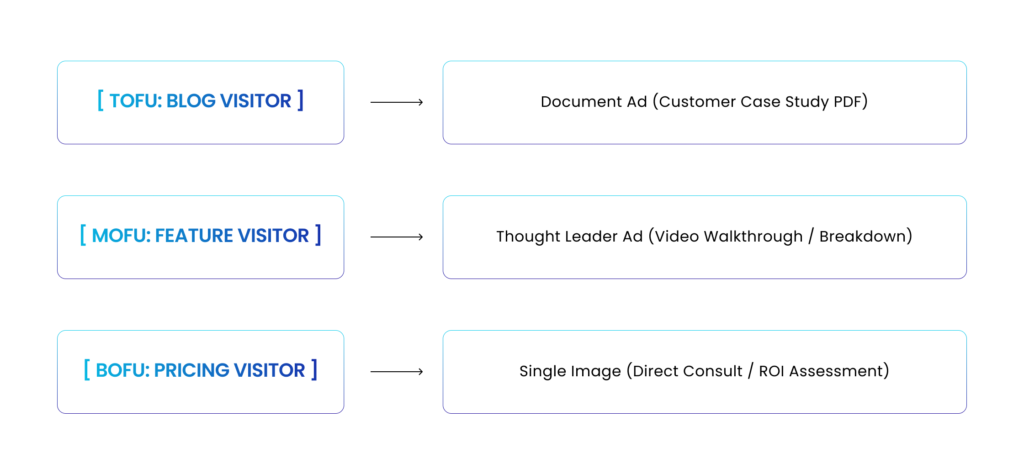
- For Tier 1 (Low Intent): Share ungated Document Ads featuring client success stories, industry benchmark reports, or expert breakdown posts. Do not ask for a sales meeting yet.
- For Tier 2 (Medium Intent): Serve feature comparison charts, customer video testimonials, or interactive product demos that show how your solution solves their exact problem.
- For Tier 3 (High Intent): Deliver direct, high-value conversion offers such as a personalized audit, free trial, or consultation with a specialist.
4. Why Retargeting Windows Matter
LinkedIn allows you to set retargeting lookback windows ranging from 30 to 180 days. Selecting the right window depends on your typical B2B sales cycle length:
- 30-Day Window (High Recency): Best for high-intent pages (Pricing/Demo) and transactional sales cycles. Recent visitors are hot leads; hitting them immediately yields the highest conversion rates.
- 90-Day to 180-Day Window (Long Consideration): Essential for complex enterprise B2B sales cycles involving long buying committee approvals. Use longer windows for top-of-funnel education to keep your brand top-of-mind over a multi-month deal cycle.
5. Eliminating Audience Overlap with Exclusions
Mandatory Exclusion Rules:
- Exclude Converted Customers/Leads: Always exclude existing clients and users who have already submitted a lead form from all retargeting campaigns.
- Exclude Higher-Intent Tiers from Lower-Intent Campaigns: Exclude Pricing Page visitors from your generic Blog Reader retargeting campaign so they only receive high-intent conversion messaging.
6. The Pragmatic Reality: Audience Size Thresholds
While hyper-segmentation sounds ideal on paper, LinkedIn Ads requires a minimum audience size of 300 active members for a campaign to deliver.
If your website receives 2,000 total visits a month, breaking that traffic into five granular URL segments will result in tiny audiences that fail to meet delivery thresholds or spend budget.
The Mid-Market Workaround: If your site traffic is modest, group your retargeting into just two practical buckets:
- High Intent (Pricing/Demo/Contact) and
- General Intent (All Other Pages).
As your top-of-funnel traffic scales, you can introduce more granular URL segmentation.
7. Managing Frequency to Prevent Fatigue
Because retargeting pools are naturally smaller than cold prospecting audiences, ad frequency rises rapidly. Serving the same ad 12 times in a week to a retargeting audience doesn’t increase conversion; instead, it generates brand annoyance.
- Keep Frequency Balanced: Aim for an average weekly frequency of 3.0 to 5.0 across retargeting campaigns.
- Rotate Creatives Regularly: Include 3 to 4 creative variations in every retargeting campaign so users see different visual angles and hooks even if the underlying offer remains constant.
8. Measuring True Retargeting Impact
Evaluating retargeting purely on direct Click-Through Rates (CTR) or initial CPL paints an incomplete picture. Because retargeting acts as a pipeline acceleration engine, evaluate success across the entire revenue funnel:
- Pipeline Velocity: Do target accounts exposed to retargeting ads move through sales stages faster than unexposed accounts?
- Account-Level Opportunity Rate: What percentage of retargeted companies convert into active pipeline opportunities?
Build a Conversation, Not a Repetitive Loop
Retargeting on LinkedIn is not about chasing visitors across the internet until they surrender their contact information. It is about recognizing where a prospect stands in their buyer journey and serving the exact piece of value, proof, or perspective required to take the next step.
By replacing blanket retargeting with intent-driven segmentation, clear exclusions, and tailored messaging, you transform your retargeting campaigns from annoying digital noise into a highly predictable pipeline driver.
Make your next LinkedIn retargeting campaign a huge success!
Book a consultation call today
![[ UNGATED / LOW FRICTION ] ──► E-Book / Checklist ──► High Volume / Low CPL / Low Intent vs. [ HIGH FRICTION / HIGH INTENT ] ──► Demo / Discovery Call ──► Low Volume / High CPL / High Intent](https://shivyaanchi.com/wp-content/uploads/2026/10/Frame-27193-750x500.png)