Fast-paced, direct-to-consumer ad campaigns designed to trigger immediate impulse buys.
For years, performance marketing carried this same consumer-centric reputation.
But lately, our digital enterprise ecosystem has changed B2B performance marketing. Performance marketers are now expected to provide a definitive engine for predictable revenue growth.
And hence, we are seeing the vanity metrics for “performance” in marketing shifting from impressions, likes, and clicks to 6-figure contract values.
Why is that happening?
Because digital is no longer an “optional, good-to-have” marketing strategy anymore. With every passing day, the market competition is becoming fiercer, and so are the ROI expectations.
Modern B2B growth demands a performance strategy engineered to acquire target accounts, accelerate pipeline velocity, and directly maximize Return on Investment (ROI).
In this article, we’ll discuss how modern B2B companies can create a high-yielding Performance Marketing framework without losing out on any platform and within budget.
But first, let’s understand what Performance Marketing is in the first place.
What Is B2B Performance Marketing?
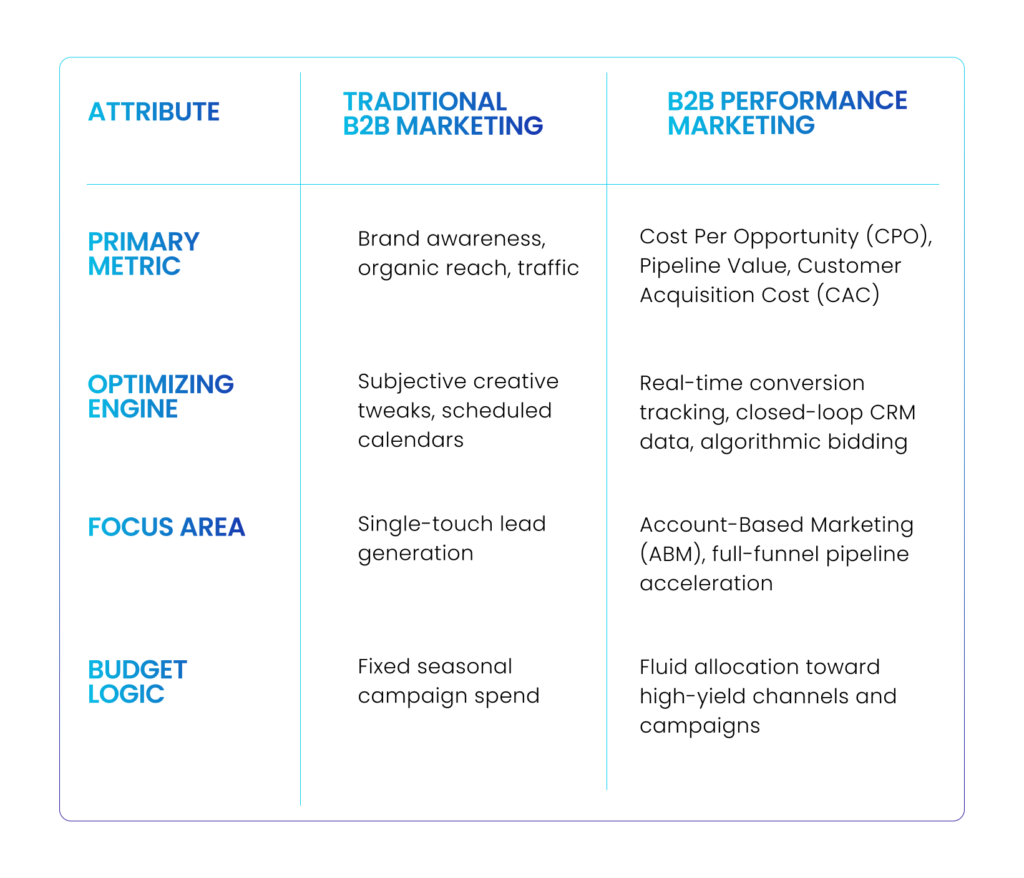
B2B Performance Marketing is a data-driven digital marketing approach where budget allocation, channel optimization, and tactical execution are tied strictly to measurable business outcomes. Outcomes such as Qualified Leads (MQLs/SQLs), Pipeline Opportunities, Sales Acceptance Rates, and Closed-Won Revenue.
Unlike traditional brand building or top-of-funnel content distribution, performance marketing operates on measurable accountability:
 Multi-Channel Playbook for B2B Performance Marketing
 Multi-Channel Playbook for B2B Performance Marketing
No single channel can carry a B2B performance program alone. Enterprise decision-makers navigate multiple touchpoints across platforms before engaging sales. Success requires aligning specific channels with distinct stages of the buying journey.
A. LinkedIn Ads: Precision Targeting & ABM Execution
LinkedIn Ads serves as the primary paid social engine for B2B performance because it allows targeting by job title, company size, industry, and exact account lists (ABM).
Tactics:
- Thought Leadership Ads: Promote native posts by company executives that highlight specific customer problems or case study results rather than generic product features.
- Document Ads: Gate high-value industry benchmarks, ROI calculators, or whitepapers directly within the feed to capture lead data without forcing website redirect friction.
- Matched Audiences: Upload your target account list (TAL) and serve tailored messaging to decision-makers within those specific accounts.
- Conversion Focus: In-feed Lead Gen Forms paired with retargeting sequences for users who clicked but did not submit.
B. Google Search (PPC): Capturing High-Intent Demand
Google Search captures buyers at the precise moment they actively seek solutions. While cost-per-click (CPC) rates can be high in B2B software and professional services, conversion rates for search stay strong because intent is pre-established.
Tactics:
- Competitor Alternative Bidding: Bid on terms like “[Competitor] alternatives” or “[Competitor] vs [Your Brand]” to catch buyers during vendor evaluation stages.
- Problem-Centric Long-Tail Keywords: Avoid broad keywords (e.g., “ERP software”) in favor of specific commercial queries (e.g., “cloud ERP for mid-market manufacturing”).
- Dynamic Landing Pages: Match the exact search query keyword with dedicated landing page headlines to keep quality scores high and reduce CPL.
- Conversion Focus: Direct demo requests, custom pricing inquiries, or interactive product tours.
C. Email Performance & Cold Nurture Sequences
Email remains one of the highest-ROI B2B channels when executed as an automated, highly segmented performance program rather than a generic monthly newsletter.
Tactics:
- Behavioral Trigger Workflows: Send targeted follow-ups based on specific actions (e.g., user read a case study → trigger an email offering a 1:1 strategy session).
- Account-Based Nurturing: Deliver multi-threaded email sequences designed for different personas within the same target account (e.g., ROI messaging for the CFO, technical integration details for the CTO).
- Conversion Focus: MQL-to-SQL progression, booking discovery calls.
The 4-Step Framework for Maximum B2B Marketing ROI
To scale performance marketing without draining ad budget on unqualified leads, structure execution using this 4-step architecture:
![[ Step 1: Definition ] ---> [ Step 2: Architecture ] ---> [ Step 3: Execution ] ---> [ Step 4: Closed-Loop ] Define ICP & Data Build Hybrid Funnel Agile Optimization Revenue Attribution](https://shivyaanchi.com/wp-content/uploads/2026/08/Frame-27105-1024x610.png)
Step 1: Define Your ICP & Intent Signals
Performance spending fails when targeted broadly. Before launching ads:
- Map your Ideal Customer Profile (ICP): Document firmographics (revenue, headcount, geography) and technographics (tech stack used).
- Layer Intent Data: Integrate first-party website interaction data with third-party intent tools (e.g., Bombora) to target accounts that are currently researching solutions in your category.
Step 2: Build a Hybrid Demand Capture & Creation Funnel
Balance short-term conversion with long-term brand equity:
- Demand Capture (60% Spend): Allocate capital to capture existing intent via Google Search PPC, LinkedIn ABM targeting, and direct retargeting.
- Demand Generation (40% Spend): Run un-gated, high-value video content and industry insights through LinkedIn Ads to build brand trust within target accounts before they enter an active buying cycle.
Step 3: Enforce Strict Pipeline Health Metrics
Look beyond Cost Per Lead (CPL). Align campaign metrics directly with pipeline health:
PipelineVelocity = (Active Opportunities × Average Deal Value × Win Rate) ÷ SalesCycleLength(Days)
Key Optimization Gateways:
- MQL to SQL Conversion Rate: Aim for a 20-30% threshold. If below 10%, tighten ICP parameters on paid ad platforms immediately.
- Cost Per Opportunity (CPO): Measure the exact paid ad spend required to generate an actual qualified sales opportunity.
Step 4: Implement Closed-Loop Revenue Attribution
To calculate real ROI, connect digital ad platforms directly to your CRM (Salesforce, HubSpot):
- Multi-Touch Attribution (MTA): Credit touchpoints across the full buyer journey rather than relying on first-touch or last-touch models.
- Feedback Loops: Route pipeline status updates back to the ad platform through conversion APIs (e.g., LinkedIn Offline Conversions). Train platform algorithms to optimize toward SQL creations and Closed-Won deals rather than simple form submits.
The Performance in B2B Marketing
Instead of running isolated ad campaigns, B2B performance marketing is all about building a scalable, measurable engine that turns paid media into a qualified pipeline. By targeting clear ICPs, leveraging platform-specific strengths, and optimizing based on revenue attribution rather than vanity clicks, B2B companies can consistently maximize ROI and outpace competitors.
Let’s build your winning B2B performance framework today!
Book a 360° B2B growth call now