The ghosts of outdated B2B growth strategies still haunt B2B companies in 2026.
But why are they letting it haunt them still? Because it used to work.
Read that again. “It used to work”. Not anymore.
Things are changing. The Internet and digital marketing have changed the world… and they have changed the B2B industry, too.
Gone are the days when you used a few sales tricks, called it marketing, forgot the clear line between sales and marketing, converted a few clients, and went on to boast about how amazing your growth strategy was.
This new era doesn’t seem to be working like that anymore.
With cutthroat competition and scrolling overstimulation, even your B2B buyers need a good story before they vouch for you, and the entire buying panel nods along with “Yes, we should purchase from this business!”
And traditional B2B companies are puzzled about how to tackle this new generation of the B2B ecosystem.
The Myth of the Hyper-Rational B2B Buyer
For decades, traditional B2B companies operated under a single, deeply flawed assumption: B2B buyers make decisions purely based on logic, ROI spreadsheets, and feature checklists.
Because of this myth, B2B marketing devolved into a sea of sameness. Companies slapped three shades of corporate blue on a landing page, packed their pitch decks with dry buzzwords like “synergy,” “end-to-end framework,” and “robust infrastructure,” and left cold calling to do the heavy lifting.
Marketing wasn’t treated as an engine of brand desire but as a glorified PDF delivery service.
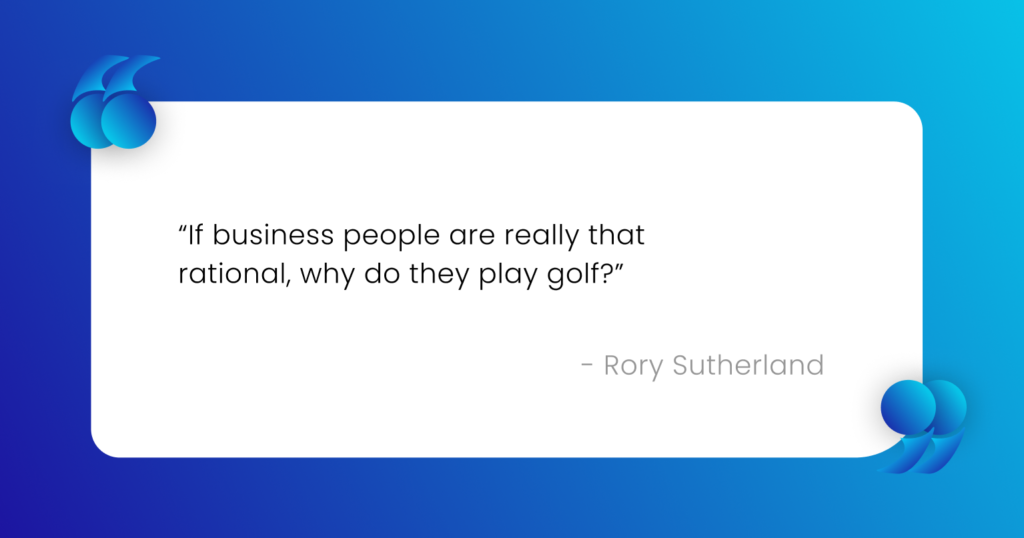
Rory Sutherland, Vice Chairman of Ogilvy and legendary behavioral economist, famously exposed this fallacy with one sharp question:
“If business people are really that rational, why do they play golf?”
If every corporate decision were purely cold, calculated, and mathematically optimized, millions of dollars in business wouldn’t be negotiated on 18-hole grass courses over hours of casual conversation, banter, and human bonding.
B2B buyers don’t strip away their human psychology the moment they log into Slack or open an enterprise email inbox. In fact, because enterprise purchases involve high budgets, multi-stakeholder scrutiny, and personal career risks (nobody wants to be the executive who championed a failed $200k software migration), emotion plays a far bigger role in B2B than in B2C.
Logic gets your company onto the shortlist; emotion is what actually gets you chosen.
Why Emotional Marketing is Winning the Digital Feed
In a feed flooded with generic AI-generated advice and copycat SaaS platforms, standard feature-led marketing gets instantly scrolled past.
Modern B2B buyers, dominated by Millennials and Gen Z digital natives who now make up over 60% of enterprise buying committees, demand memorable experiences. They want personality. They want brands that stand for something, make them feel understood, and bring a touch of joy to an otherwise mundane workday.
If your marketing looks, feels, and talks like every other corporate vendor, you become invisible. To break through, forward-thinking brands are throwing out the sterile B2B playbook and injecting emotional storytelling and gamification into every touchpoint.
The Cases in Point
-
Tinct AI Broke the “Blue SaaS” Mold
I love finding companies like Tinct AI that take bold and unconventional steps to stand out in their respective B2B markets. Behind their stellar branding goes the idea of leveraging the expertise of a designer with 20 years of experience. On top of that, they’ve designed and produced their own game for the loading page.
Take a look at this recent post from the VP of Growth at Tinct AI, reflecting on why they broke standard B2B design conventions:
Why are Jean and the team at Tinct AI gamifying the buyer experience?
Because they understand that waiting for a platform screen to load is usually a micro-moment of friction and boredom. By replacing that dull spinner with a retro pixel-art game, they turn a tedious technical necessity into an unexpected moment of delight.
It isn’t “rational” according to traditional B2B metrics, but it is deeply human. It builds brand recall, sparks word-of-mouth chatter, and transforms a prospect’s perception of Tinct AI from a faceless software tool into a creative, thoughtful partner.
Case in point 2: Mutiny’s unconventional commercial
Check out this super cool and hilarious ad film by Mutiny. That fox, cute much?
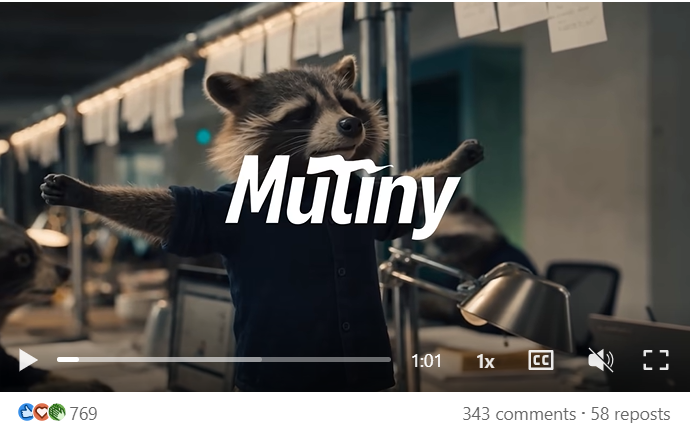
With this ad film, Mutiny is announcing their newly built automation layer for their AI agent that disrupts the load of the entire GTM stack and replaces it with one AI agent.
As per them, Mutiny connects with your email, calendar, CRM, call recording, Slack, and 50+ tools to extract data and do work on your behalf.
You see how they are using exciting and imaginative storytelling and emotions in this B2B commercial? B2B needs that kind of revolution from every company if they want to stay relevant in this market.
The Psychology of the B2B Marketer (And Buyer)
At the end of the day, B2B marketers and B2B buyers share the same fundamental psychology: they are human beings.
When a decision-maker closes their laptop at 5:00 PM, they go home to stream shows, laugh at memes, listen to podcasts, play games, and connect with stories that make them feel something. They don’t magically morph into cold, emotionless algorithms when they open their laptops at 9:00 AM the next morning.
They still feel anxious about making the wrong decision. They still feel pride when their team succeeds. They still crave delight over boredom, simplicity over complexity, and authenticity over corporate jargon.
Traditional B2B companies aren’t marketing themselves enough because they are still clinging to the safety blanket of dry, feature-based selling. But in a crowded, hyper-competitive marketplace, safe is the most dangerous thing you can be.
Good storytelling is becoming non-negotiable in B2B with every passing day. It has become the ultimate strategic imperative. Because this is the attention economy, and modern B2B buyers are directly or indirectly seeking that creative connect with brands.
When you tell a story that connects with the human behind the title, you stop fighting for attention and start building a brand that buyers actively fight to work with.
We Are Witnessing This B2B Storytelling Need in Our Projects Too
Though an NDA doesn’t allow us to reveal what we are working on right now, we are also noticing how creatively bold expressions are fetching more attention for our clients.
We are constantly studying and implementing ideas to turn a B2B idea into a mode of entertainment that the audience can’t ignore. And it has been working.
Are you ready to story-fy your B2B idea?